We spent four days in Salzburg in December, exploring the Old Town, riding the Festungsbahn up to Hohensalzburg Fortress, following Sound of Music locations, visiting Mozart sites, and sampling schnapps along the way.
December adds Christmas markets to the mix, but Salzburg in winter isn’t limited to Advent. The fortress, museums, churches, concerts, and Old Town are all still here after the market stalls come down.

4-Day Winter Itinerary for Salzburg
We had four days in Salzburg, which gave us time to see the main sights without racing through them.
Day 1: Old Town and Mozart
Start with Getreidegasse, Mozart’s Birthplace, and the surrounding Altstadt. Mozart’s Residence is across the river on Makartplatz, so you can add that while you’re on the Mirabell side of town.
And while you’re on Getreidegasse, stop at Sporer. We did, and sampling schnapps in a tiny shop that has been there since 1903 is not a bad way to deal with a cold December day.
In the evening, you’ll find Mozart concerts at venues including Mirabell Palace and Hohensalzburg Fortress.
Day 2: Hohensalzburg Fortress and the Christmas markets
Ride the Festungsbahn up to Hohensalzburg Fortress and give yourself time for the museums as well as the views.
When you come back down, you’re right near the cathedral, Residenzplatz, and Mozartplatz. In December, that also puts you in the middle of the main Christkindlmarkt on Domplatz and Residenzplatz.
There’s another Advent market up at the fortress, so you can hit two without making a separate trip across town.
Day 3: The Sound of Music
Our Sound of Music tour took us outside Salzburg into the Salzkammergut as well as to filming locations in and around the city, including Mondsee and Hellbrunn.
Back in Salzburg, you can see more film locations around the city, including Mirabell Gardens, Residenzplatz, the Horse Pond, and the Felsenreitschule.
Day 4: Churches, Mirabell, and whatever you missed
Use the last day for places you didn’t get to earlier: Mirabell Palace, St. Peter’s Abbey, Holy Trinity Church, St. Blasius Church, the Marionette Theatre, or one of the Mozart sites.
Mirabell Gardens are open in winter, but don’t expect them to look like the summer photos. Parts of the garden close for the season, including the Hedge Theater and Dwarf Garden.
Leave yourself some time to wander, too. We found plenty to stop for between the main sights.
What to Do in Salzburg in Winter

Most of Salzburg’s main sights stay open in winter. In December, you also get the Christmas markets, so sightseeing and Advent tend to overlap whether you plan it that way or not.
💡 BUDGET TIP: If you plan to visit several paid attractions, the Salzburg Card is worth pricing out. It comes in 24-, 48-, and 72-hour versions and includes public transportation plus admission to many of Salzburg’s main attractions.
Enjoy the Christmas markets
Salzburg is one of those cities where you don’t have to go looking for the Christmas markets. If you’re sightseeing in the Old Town in December, you’re going to run into them.
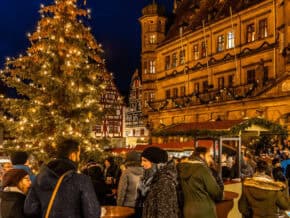
The main Salzburg Christkindlmarkt fills Domplatz and Residenzplatz beside the cathedral. Its roots go back to a pre-Christmas market held here in the late 1400s, although the current Christkindlmarkt dates from 1974. Today, the stalls spread across the two squares and part of Kapitelplatz, selling ornaments, handicrafts, food, and plenty of Glühwein.
Mirabellplatz has a smaller market across from St. Andrew’s Church, and there’s another Advent market up at Hohensalzburg Fortress.
You’ll also find smaller markets around Salzburg, including Alter Markt and Hellbrunn Palace.
And Christmas Eve isn’t necessarily the end of market season. The main Domplatz/Residenzplatz Christkindlmarkt continues through New Year’s Day, while the Mirabellplatz market stays open through New Year’s Eve.
Take the Festungsbahn to Hohensalzburg Fortress

The Festungsbahn has been carrying passengers up the Festungsberg since 1892. The trip is only about 200 meters and takes less than a minute.
Hohensalzburg Fortress dates back to 1077, when construction began under Archbishop Gebhard. It was expanded over the centuries, with much of the fortress you see today taking shape around 1500. Its purpose was to protect Salzburg’s prince-archbishops and their territory.
The views over Salzburg and the surrounding mountains are reason enough to go up, but there’s plenty to see inside, too. The fortress contains the Fortress Museum, Marionette Museum, historic armory, and Rainer Regiment Museum, along with the Gothic Prince’s Rooms. Those rooms still have their original furnishings from 1501–1502.
In December, the fortress also hosts an Advent market.
Attend a performance of Mozart’s music
Salzburg is Mozart’s hometown, and concerts are everywhere.
Mirabell Palace hosts performances in the Marble Hall, and Hohensalzburg Fortress has evening concerts as well. If you already plan to visit either one, a concert is an easy addition.
Tour Mozart’s birthplace and residence
Mozart was born in an apartment on Getreidegasse in 1756 and spent much of his childhood there. Today, his birthplace is a museum with family possessions, letters, portraits, and his childhood violin. You also get a look at what an 18th-century Salzburg apartment was like.
The family moved to the Mozart Residence on Makartplatz in 1773. This was a much larger home, with eight rooms and a concert hall where Mozart performed along with his equally talented sister, Maria Anna, better known as Nannerl.
By the time you’ve spent a few days in Salzburg, you’ll have seen Mozart everywhere. Visiting the two houses gives you the history behind all of it.
Wander through the Altstadt

Salzburg’s historic center has been a UNESCO World Heritage Site since 1996, and Getreidegasse is the street everyone eventually ends up on.
The wrought-iron shop signs are almost as noticeable as the shops themselves, and there’s no shortage of Mozart merchandise. In December, garlands and lights get added to the mix.
After Mozart’s Birthplace, keep walking down Getreidegasse instead of treating it as a street you simply pass through. The churches, courtyards, shops, cafés, and old buildings are part of what makes the Altstadt interesting. If you’d rather have someone explain what you’re looking at, there are also guided walking tours.
We spent plenty of time simply walking here. That’s also how you come across places like St. Blasius Church, the Horse Pond, and the small courtyards tucked between the main streets.
Sample schnapps at Sporer
While you’re on Getreidegasse, stop at Sporer Liqueur and Punch Manufacturer. The shop has been here since 1903 and occupies the narrowest house on the street.
Sporer makes 18 different liqueurs and sells dozens more, so there’s plenty to sample if you want to try something besides the usual schnapps.
ⓘ SOUVENIR IDEA: A bottle from Sporer is easy to pack and makes a very Salzburg souvenir.
Join a Sound of Music tour
Many American movie fans know Salzburg as the setting for The Sound of Music, but the filming locations aren’t limited to the city.
Our Sound of Music tour took us through the Salzkammergut, past the lakes and mountains east of Salzburg, and on to Mondsee Church, where the wedding scene was filmed. In real life, Maria and Captain von Trapp were married at Nonnberg Abbey.
We also stopped at Hellbrunn Park to see the gazebo, then visited Nonnberg Abbey, where Maria had been a novitiate. The abbey was founded in the early 700s and is one of Salzburg’s oldest religious institutions.
Back in the city, several other locations are easy to spot, including Mirabell Gardens, Residenzplatz, the Horse Pond, Felsenreitschule, and St. Peter’s Cemetery.
More Salzburg Attractions
The rest of these sights are scattered around the Altstadt and the Mirabell side of the river, so you’ll pass several of them while walking between the bigger stops.

Residenzplatz
Residenzplatz sits between Salzburg Cathedral, the Alte Residenz, the Neue Residenz, and a row of old townhouses.
Prince-Archbishop Wolf Dietrich von Raitenau had the square laid out as part of his redevelopment of Salzburg, which meant demolishing 55 medieval buildings to make room for it.
The large fountain in the center dates to the 17th century. If it looks familiar, The Sound of Music used Residenzplatz during Maria’s “I Have Confidence” sequence.
In December, the main Salzburg Christkindlmarkt spreads across Residenzplatz and Domplatz.
Mozartplatz
Mozartplatz is just around the corner, with a large Mozart statue in the center.
The statue was supposed to be unveiled in 1841 for the 50th anniversary of Mozart’s death, but workers uncovered a Roman mosaic while preparing the site. The ceremony was delayed until 1842 while the mosaic was recovered.
Mozart’s sons attended the unveiling, and Bavaria’s King Ludwig I paid for the marble pedestal.
Pferdeschwemme (horse pond)
Salzburg once had several horse ponds where horses could be washed and watered. The surviving Pferdeschwemme near the end of Getreidegasse was redesigned in the 18th century.
The center figure is a horse tamer, with painted scenes and decorative stonework around the basin.
It doesn’t take long to see, but it’s another one of those odd little Salzburg details you notice while walking between bigger attractions.
Felsenreitschule (Rock Riding School)
Felsenreitschule literally means “Rock Riding School,” which tells you what the place originally was.
Built into a former quarry, the theater has 96 arches cut into the rock across three levels. It was originally used as a riding school and performance arena before becoming one of Salzburg’s best-known theater spaces.
It’s still used for performances, including during the Salzburg Festival.
Mozart University (Universität Mozarteum)
The Mozarteum traces its history to 1841, when Salzburg founded a music institution in Mozart’s name.
Today, Universität Mozarteum teaches music, theater, dance, and other performing arts and puts on hundreds of public events each year.
The old article said the building itself dated to 1841. That isn’t correct—the institution does.
Holy Trinity Church (Dreifaltigkeitskirche)

Holy Trinity Church was built between 1694 and 1702.
The exterior is easy to overlook when you’re walking around Makartplatz, but we loved quietly wandering around inside and looking at the details.
Landestheater (Makartplatz)
The Salzburg Landestheater stands near Mirabell Palace and stages opera, theater, ballet, and musicals.
The present building opened in 1893, but there had been a court theater on the site since 1775. Mozart’s music was performed in that earlier theater, and regular performances of his repertoire began there in 1784.
So Mozart did not perform regularly in the building you see today. The building came more than a century later.
Marionette Theater (Marionettentheater)
The Salzburg Marionette Theatre opened in 1913 and is still operating today.
Its performance tradition was added to Austria’s UNESCO Intangible Cultural Heritage list in 2016. The repertoire includes Mozart, operettas, children’s productions, and The Sound of Music.
St. Blasius Church
St. Blasius Church sits at the end of Getreidegasse, so it’s easy to pop in while you’re already walking through the Old Town.
The church dates back to the Middle Ages and combines several architectural styles as a result of later changes over the centuries.
The Riedenburg district

Riedenburg is one of Salzburg’s older residential districts, with Rainberg rising behind it.
People were living on Rainberg as far back as about 4500 BC. The hill was later fortified by Celtic settlers before the Romans arrived and shifted the center of settlement toward what is now the Altstadt.
We enjoy ancient sites like this, but Rainberg is now a protected nature area and not officially open to the public. So, no hill for us.
Schloss Leopoldskron sits nearby beside Leopoldskroner Weiher. Prince-Archbishop Leopold Anton Firmian commissioned the palace in the 18th century as a family residence, and movie fans will probably recognize the setting from The Sound of Music.
One thing has changed from the old advice in this article: the palace and grounds are not open for ordinary sightseeing. You can still see the lake and palace from outside the property, and several Sound of Music tours stop in the area.
Mirabell Palace and Gardens

Mirabell Palace dates to 1606. The Marble Hall is still used for concerts, and both the palace and gardens are free to visit.
The gardens are one of Salzburg’s best-known Sound of Music locations, with the Pegasus Fountain appearing in “Do-Re-Mi.”
Winter is not when the gardens look their best. The Hedge Theater and Dwarf Garden close for the season, and parts of the gardens may also be closed.
We still think it’s worth walking through if you’re already visiting Mirabell Palace or Mozart’s Residence on this side of the river. You can also catch a Mozart and Vivaldi performance in the Marble Hall.
Schloss Hellbrunn
Schloss Hellbrunn was built in the early 17th century as a summer residence for Prince-Archbishop Markus Sittikus.
In December, the palace grounds are also used for the Hellbrunn Advent market, so the setting has a completely different feel from summer.
The famous trick fountains are a warm-weather attraction, though, so don’t expect the normal summer Hellbrunn experience in winter.
St. Peter’s Abbey
St. Peter’s Abbey was founded in the 7th century and is considered the oldest monastery still operating in the German-speaking world.
The cemetery is even older than the abbey, and the catacombs are carved into the rock of the Festungsberg. The Sound of Music used the cemetery and catacombs as inspiration for scenes in the film.
How to Get to Salzburg Austria
Salzburg’s W.A. Mozart Airport (SZG) is only about 4 km from the city center. There’s no train station at the airport, but Bus 2 connects the airport with Salzburg Hauptbahnhof and Bus 10 runs to the city center. Taxis are available as well.
If you’re coming by train from another European city, you’ll arrive at Salzburg Hauptbahnhof, the city’s main station.
Driving and long-distance buses are options too, though you won’t need a car for sightseeing in central Salzburg.
Getting around Salzburg
Salzburg’s historic center is compact enough that we did our sightseeing on foot. That’s the easiest way to see the Old Town, although snow or ice can obviously slow things down.
Salzburg also has an extensive bus and Obus network. The Obus is a trolleybus, not a tram, and the same ticket system covers the city network. You can buy single-ride and 24-hour tickets from machines, online, or through the local transit app.
If you plan to visit several paid attractions, compare the cost of a Salzburg Card. It comes in 24-, 48-, and 72-hour versions and includes public transportation plus admission to many of Salzburg’s main attractions.
Where to stay in Salzburg
Because Salzburg’s city center is compact, it’s easy to get around on foot. I recommend staying in or near the Altstadt so you can walk to most of the places in this guide.
The Old Town spreads across both sides of the Salzach River. Getreidegasse, the cathedral, Residenzplatz, and Hohensalzburg Fortress are on the south side; Mirabell Palace and the train station are on the north.
If you decide to stay farther out to save money, look for somewhere near a bus or Obus stop so you can get into the center easily.
Salzburg winter weather
Salzburg gets properly cold in winter, with short days and a chance of snow from December through February. We were there in December, when the Christmas markets were in full swing.
Snow in the Old Town varies from year to year, but the Alps are right there in the background, so you still get the mountain scenery even if the streets aren’t covered in white.
You’ll be outside a lot, so warm layers and shoes with decent traction are useful. And when you get cold, there’s usually a church, museum, café, concert, or Glühwein stand nearby.
Thoughts About Visiting Salzburg in winter
Four days worked well for us. We had enough time for the Old Town, Hohensalzburg Fortress, Mozart sites, Christmas markets, and a Sound of Music tour without trying to squeeze everything into one day.
December adds the Christmas markets, while January and February still give you the museums, churches, fortress, concerts, and Old Town.
If you have less time, our one-day city itinerary shows how much you can fit into a shorter visit.
💡 Want more winter trip ideas?
In the U.S., we’ve covered the best New England winter getaways, things to do in NYC in winter, warm winter vacations in the USA, and the top day trips from Orlando and Miami.
For Europe, there are the best European Christmas markets, Christmas in Crete, and places to visit in Europe in December. We also have cold-weather guides to Vienna, Munich, Salzburg, Hallstatt, Zagreb, and Ljubljana, plus a winter packing list and a guide to European Christmas food traditions to try.
For winter in the Southern Hemisphere, we’ve covered the best ski resorts in Australia.