Hallstatt is one of those places that hardly looks real. Wedged between the mountains and Lake Hallstatt, the village is famous for its 16th-century Alpine houses, ridiculously photogenic setting, and a history that goes back a whole lot farther than the pretty buildings.
Salt has been mined here since prehistoric times—about 7,000 years, in fact—and for centuries Hallstatt was so isolated that the only ways in were by boat or narrow mountain trails. Fortunately, getting here is easier these days.
We visited Hallstatt in winter and spent two days exploring the village. Some days were snowy, some weren’t, but the mountains around the lake looked wintry the whole time.
Winter also changes how you need to plan a Hallstatt trip. Daylight is short, some attractions close for part of the season, and a day trip from Vienna or Salzburg eats up a surprising amount of your day.
This guide covers what to expect in winter, how to get there, what stays open, and how we spent our two days in Hallstatt.
What to expect in Hallstatt in winter
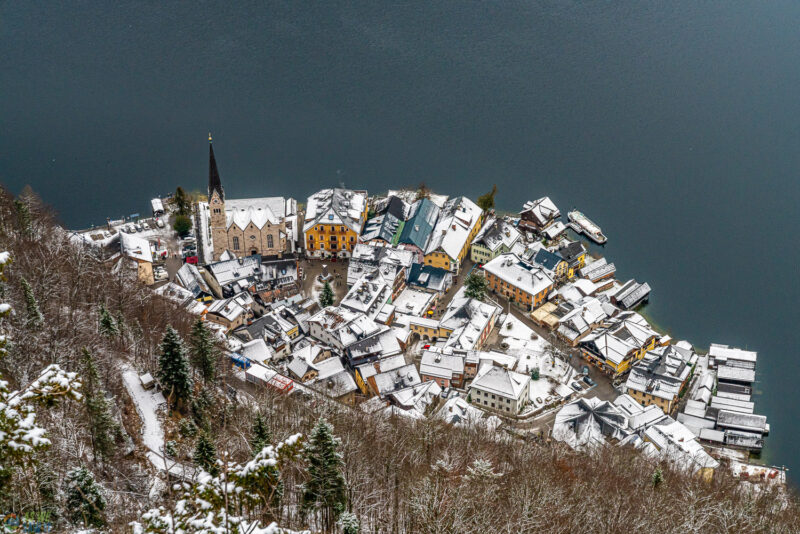
Winter in Hallstatt isn’t the same from November straight through February. So don’t count on Hallstatt looking like every snowy Instagram photo you’ve seen. Snow in the village is possible, not guaranteed. The higher elevations are a much safer bet.
November can be a bit of a toss-up. You may get snow, but you may also get cold, wet streets and bare ground in the village. That’s pretty much what happened to us—we saw both.
If you’re visiting in December, Hallstatt will be decorated for Advent, as it was when we were there. Early December brings St. Nicholas and Krampus festivities, but you can forget about a month-long Christmas market like the ones in Munich or Salzburg. Hallstatt’s traditional market takes over Market Square for one day, on December 8, the Austrian public holiday of the Immaculate Conception.
January brings colder weather and short days, and some attractions begin their winter breaks after the Christmas/New Year period.
By February, the days are getting longer again, but some seasonal attractions may still be closed. Hallstatt itself doesn’t shut down, though. You can still explore the village, visit the museum and Bonehouse, take the ferry across the lake, and photograph the town with noticeably more daylight than you’d have around Christmas.
💡 TIP: The Hallstatt Salt Mine, Salzberg funicular, and Skywalk normally operate through the Christmas and New Year period, then close for a seasonal break. Their spring reopening date varies from year to year. And forget about visiting Dachstein Giant Ice Cave in winter, too—it’s only open from May 1 through November 1
How to get to Hallstatt
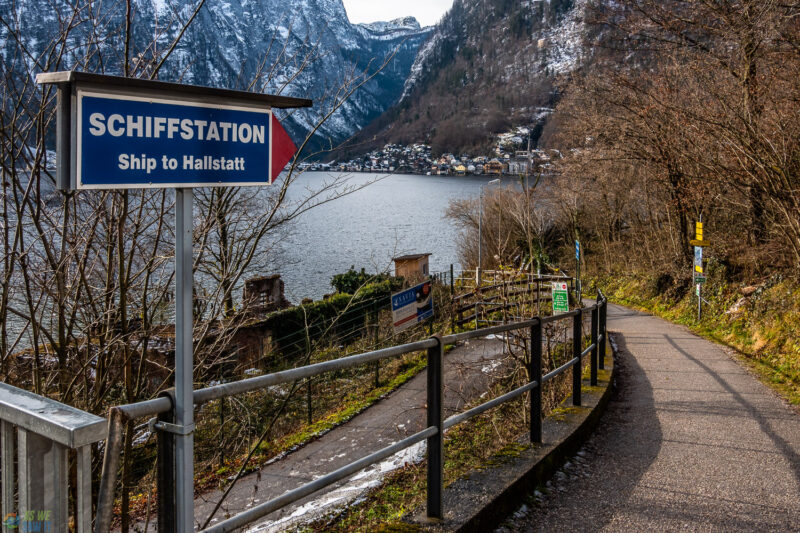
We arrived on a train from Salzburg, and then took the ferry Stefanie across the lake to Hallstatt. This journey is absolutely picture-worthy the entire way. Make sure you have your camera on hand.
The ferry runs between Hallstatt railway station and Hallstatt Markt year-round, with departures timed to meet the trains. Buses do come into Hallstatt itself and stop at Hallstatt Lahn. If you’re driving, you’ll need to leave your car in one of the public parking areas outside the pedestrian center.
Not counting the short ferry ride, it takes about 2.5 hours to get to Hallstatt from Salzburg, or around 4 hours from Vienna by train. That makes a winter day trip pretty ambitious once you factor in the short daylight hours.
It’s much better to stay overnight if you can. You’ll have more time to actually enjoy Hallstatt without spending half the day getting there and the other half watching the clock so you don’t miss the last ferry or bus out.
We stayed at Heritage Hotel Hallstatt because of its convenient location and many positive reviews. Plus, it’s in an old historical building, which offers a bit of local atmosphere.
To make the most of your first day, catch an early train. If your room isn’t ready when you arrive, drop your bags at the hotel and start exploring. Plan to eat your midday meal in Hallstatt.
Day 1: Arrive in Hallstatt + walking tour
Once you’ve dropped your bags, the rest of the day is easy to do on foot. Hallstatt is compact, so we just started walking and stopped wherever looked interesting along the way.
Visit the Evangelical Church
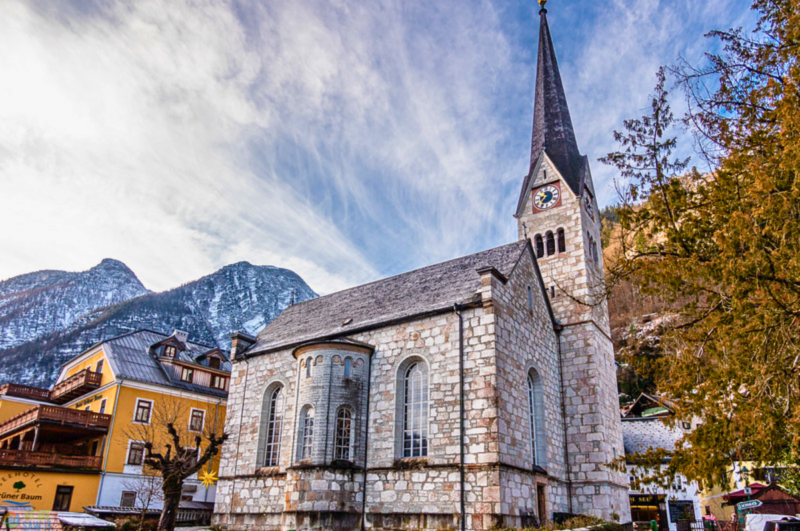
First stop: the Evangelical Church. Okay, our first stop was supposed to be lunch, but we decided to stop in the church because we’d be passing by it on the way to the restaurant.
The Evangelical Church overlooks the lake and its steeple has been a centerpiece for photographers over the years. It’s a stone church that was built in 1863, and has made the area even more beautiful than it already is!
Enjoy lunch at Zum Salzbaron inside Gruner Baum Hotel
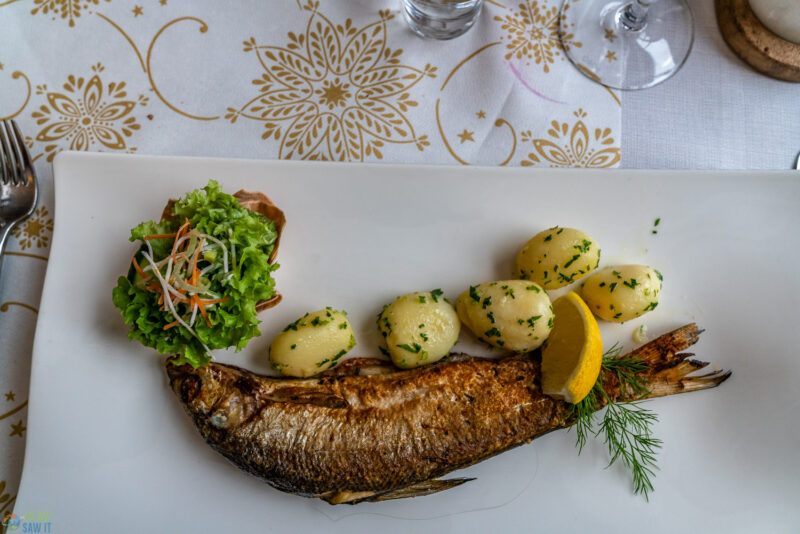
Steps from the church was our next stop: lunch at Restaurant ‘Zum Salzbaron’, which is located inside Seehotel Grüner Baum. The restaurant’s lake terrace is popular in the summer, but not in this frigid weather.
Kaiserstüberl is the cozier choice, tucked into the oldest part of the hotel. You won’t get a lake view, but it does overlook Hallstatt’s Market Square. We decided to try some of the local fish, and when it arrived, it looked almost too pretty to eat. Almost.
Walk around Hallstatt
We took some time that afternoon to explore the cute streets, wandering up random streets and stairways to see where they might lead. Dan loves to capture the personality of a place with his lens—Hallstatt is full of quaint houses and traditional shops.
If you prefer some direction instead of wandering up whichever street looks interesting, Viator has a variety of Hallstatt walking tours and self-guided audio tours. There are also photography-focused options if getting better shots is the priority.
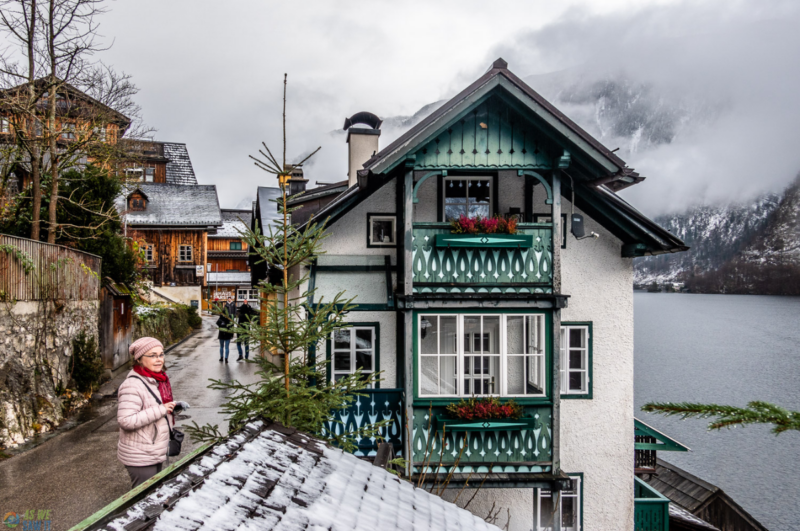
We eventually made our way back to Market Square, which is worth spending some time exploring.
The centerpiece of the square is the Holy Trinity Statue, one of the few things that dates from before 1750, the year when Hallstatt experienced a terrible fire. Most of the square was reduced to ash and rubble, four people died, and 35 houses burnt to the ground. After the disaster, the town came together to rebuild, and the statue has stood firm ever since.
Market Square is surrounded by shops, restaurants, cafes and picturesque little houses and provides plenty of new places to explore, even at the coldest time of year. Many events take place here, and there are often concerts and other social gatherings to enjoy.
💡 PRO TIP: Wear comfortable shoes with good soles while you’re here. The streets aren’t flat, there are plenty of steps and steep sections, and winter may add wet pavement, slush, snow, or icy patches to the mix.
Dinner at Seewirt Zauner Hotel Restaurant
After spending a good few hours exploring the square and surroundings, we were famished and in need of a great dinner. So we headed for dinner in a restaurant situated very conveniently in the square.
Most of the dishes at Seewirt Zauner are locally sourced. Think fish from Lake Hallstatt, organic meat from the region, game from surrounding forests and vegetables from regional producers. Keeping with the theme, they also offer a large selection of Austrian and international wines to round off the various dishes.
Naturally, we had to give it a try. It did not disappoint!
The restaurant provides lovely views over Market Square, and the delicious food that accompanies the view makes it a perfect pairing.
Nighttime shots in Hallstatt
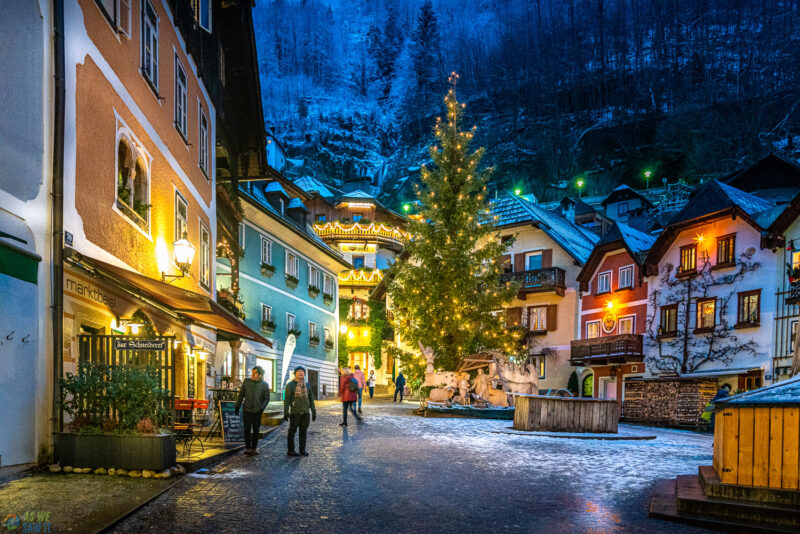
For Dan, capturing a few nighttime shots was the perfect way to end our first day in Hallstatt. If your camera can handle it, the lights of the city cast a beautiful glow on the streets.
Day 2: Explore Hallstatt + Salzberg
Our second day in Hallstatt started with some of the village’s best viewpoints, then moved on to the Bonehouse and World Heritage Museum before we headed up the Salzberg.
Winter does photographers one favor: sunrise isn’t painfully early. Around the winter solstice, it’s about 7:50 am. Unfortunately, sunset comes along pretty quickly too, so there’s not a huge amount of daylight to waste. Though by February, the days are noticeably longer than they were at Christmastime.
Photograph the classic Hallstatt viewpoint
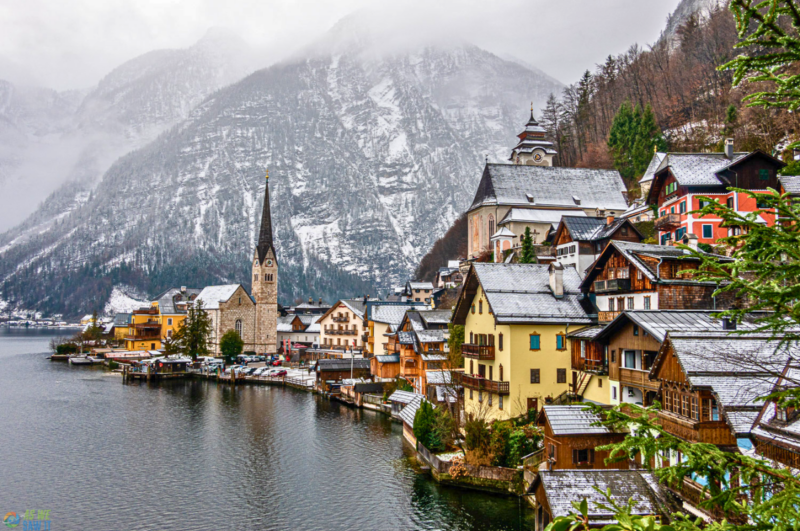
Dan was determined to get that classic postcard shot of Hallstatt, so that’s where we headed first. You’ve probably seen that view a hundred times already.
It pays to get here early, partly for the light and partly because you will definitely not be the only person who has thought of taking this photo. Photographers tend to congregate here, and once everyone starts jockeying for the same unobstructed view, peaceful little Hallstatt suddenly feels a lot less peaceful.
If you manage to arrive before full daylight, you may even catch some of the village lights still twinkling in the windows. (We didn’t.)
Give yourself a little time here. The light changes quickly as it comes over the mountains, and this is one place where taking far too many versions of the same photo is completely understandable.
Bonehouse (Charnel House or Beinhaus)
Hallstatt’s buildings are squeezed onto a narrow strip of land between the mountains and the lake, and there isn’t exactly an abundance of room for a cemetery, either.
So what do they do with all the dead people?
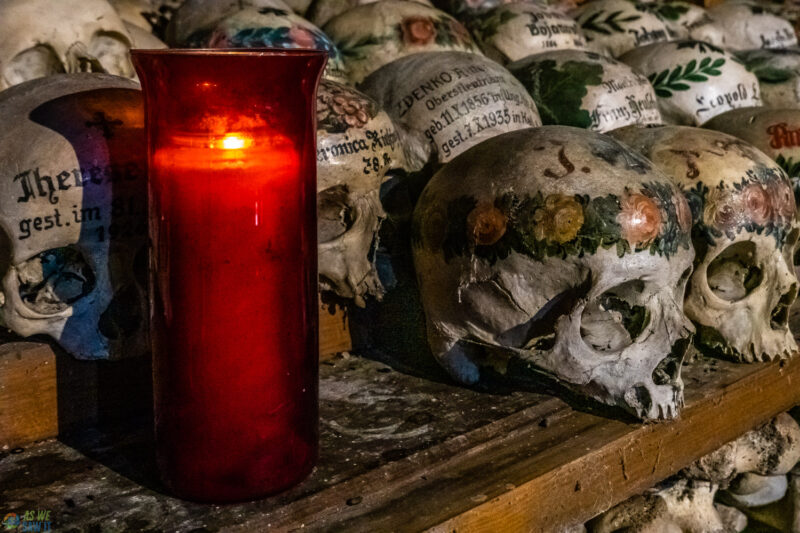
They bury them, of course. Historically, when older graves were reused, some of the remains were transferred to the Bonehouse in St. Michael’s Chapel. The old explanation that everyone simply had to be dug up after a few years because Hallstatt had run out of room is a little too neat, but the custom of moving and preserving bones here is very real.
If you’ve visited other ossuaries, such as the one in Kutna Hora, this Bonehouse is different.
Here they have an overwhelming collection of more than 600 painted skulls. Many are marked with the person’s name and date of death and decorated with crosses, flowers, leaves, and other symbols. Skull painting became especially common here during the 19th century, although the tradition continued much longer.
That’s certainly a creative way to honor and respect those who had to endure being disinterred.
Hours: The Bonehouse is open on a reduced schedule from November through March: 11:30–15:30, Wed-Sun.
Hallstatt City Viewpoint
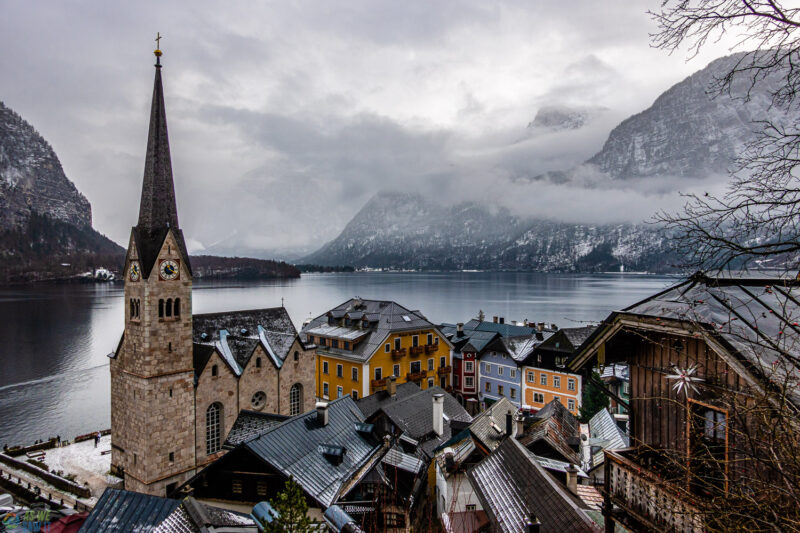
If you head toward the center of Hallstatt and look up, you’ll see wooden houses dotting the mountainside above the village. They’re part of what makes Hallstatt so picturesque, so naturally we wanted to see what the view looked like from up there.
Follow the steep steps and lanes upward. The higher you climb, the more the rooftops spread out below you, with Lake Hallstatt and the mountains beyond.
It’s a completely different perspective from the classic lake-level viewpoint, and it also makes one thing very clear: Hallstatt may be tiny, but it is most definitely not flat.
Remember that warning about comfortable shoes with good soles? This is why.
Tour the Hallstatt Museum
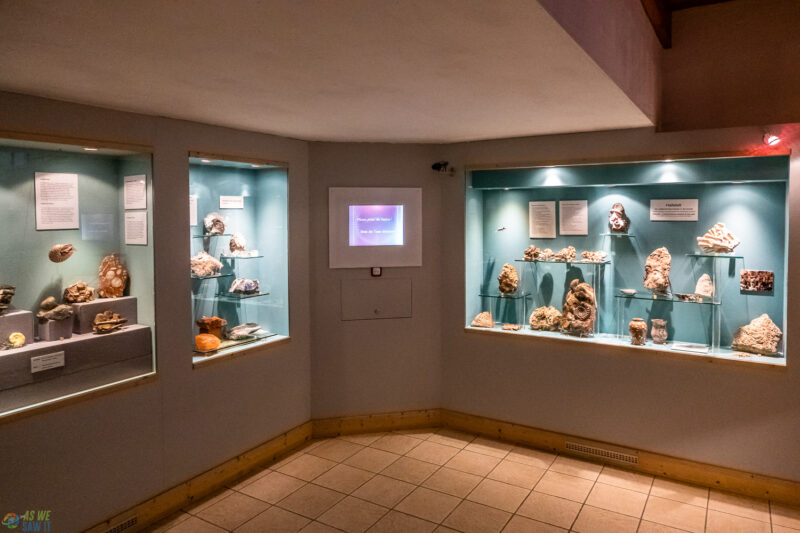
Next we visited the Hallstatt World Heritage Museum, which has an impressive collection of discoveries from the local salt mine and artifacts found in prehistoric burial grounds around Hallstatt.
You’ll also find Roman remains and exhibits covering the people who have lived in this area over thousands of years. In fact, Hallstatt gave its name to the Hallstatt culture, an important period of the European Iron Age.
After walking through the village, cemetery, and Bonehouse, the museum helped put a lot of what we’d already seen into context. Hallstatt is ridiculously photogenic, but people were living, mining, trading, and burying their dead here long before anyone cared how the village looked in an Instagram photo.
And in winter, there’s another benefit: museums are indoors.
Hours: Hallstatt World Heritage Museum is open daily, except for reduced opening days from November through December 23.
Visit the bus stop viewing area
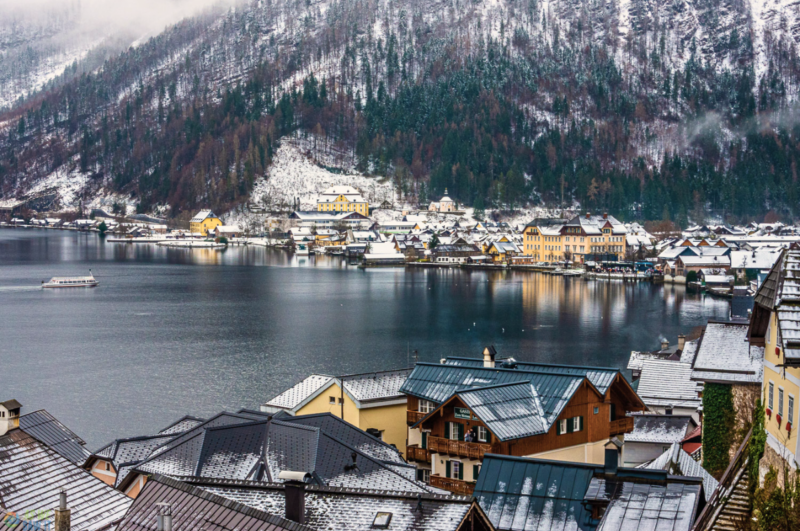
As you leave the main walking area of Hallstatt and head toward Hallstatt Lahn, you’ll come to the bus stop.
Yes, I’m recommending a bus stop as a photo stop.
The view from this end of town is completely different from the higher viewpoints we’d already visited, with the village stretched out along the lake instead of stacked below you.
There are often swans hanging around the water as well. As if mountains, a lake, Alpine houses, and church steeples weren’t quite picturesque enough.
Have lunch at Cafe Polreich
After a busy morning of walking, climbing, and taking photos, we were ready for lunch.
We stopped at Cafe Polreich, right beside Lake Hallstatt. The big windows and lakeside location are the real draw here, especially if you can get a table overlooking the water.
Our meal was nicely presented, and it was a pleasant place to warm up and take a break before heading up the Salzberg. They serve coffee, drinks, pastries, and a small selection of homemade dishes. I wouldn’t go out of my way for the food alone, but the setting makes it a nice lunch stop.
Hours: Cafe Polreich is open year-round, including winter, from 11:00 am to 6:00 pm, five days a week. Wednesday is listed as a closing day, although the cafe notes that its rest days can vary.
Ride the Salzberg funicular
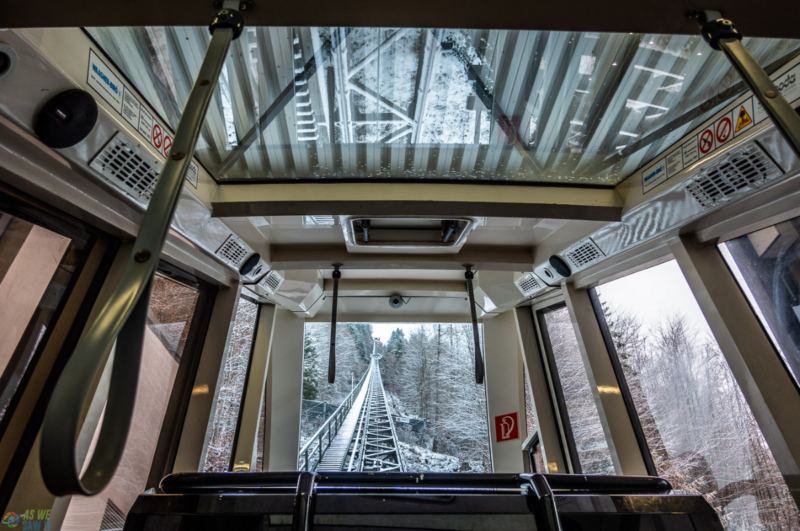
After lunch, we headed up the Salzberg funicular. The ride only takes a few minutes, but you gain a lot of elevation very quickly.
Once you’re up there, Hallstatt suddenly looks very small below you, squeezed into that narrow strip between the mountains and the lake.
The Salzbergbahn has been completely rebuilt since our visit, so today’s funicular isn’t the same one we rode. From the upper station, you can reach the Skywalk and Rudolfsturm and continue into the high valley toward the Salt Mine.
We took our time with the views, but the Skywalk wasn’t the main reason we’d come up the Salzberg. Next came one of the experiences we’d been looking forward to most: going underground in the Hallstatt Salt Mine.
Hours: The funicular normally runs from 9:00 am to 4:30 pm during its winter operating period. There’s also a combination ticket with the Salt Mine, which I think is a better deal. The Salzwelten Hallstatt schedule has the current operating dates for the funicular, Skywalk, and Salt Mine.
Enjoy views from the Skywalk
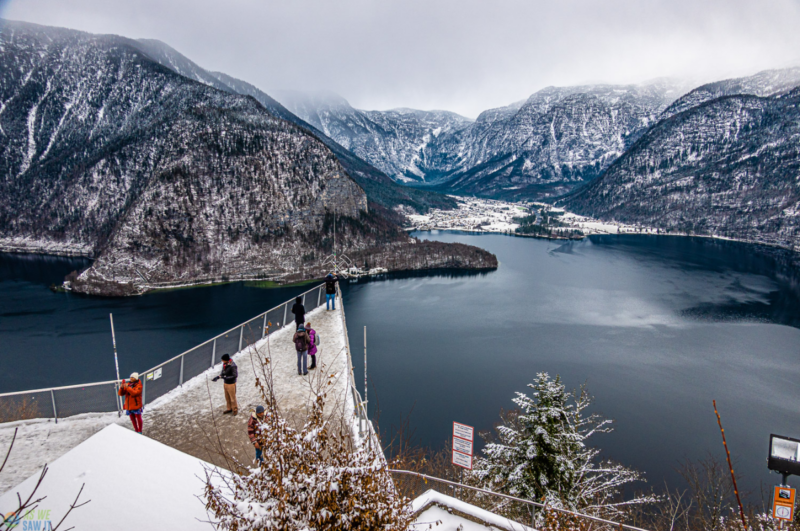
From the upper funicular station, we made our way to the Skywalk, beside Rudolfsturm.
The viewing platform extends 12 meters out from the mountainside, roughly 360 meters above Hallstatt. From up here, you get the village, Lake Hallstatt, and the surrounding mountains all in one shot.
If you want a photo of Hallstatt from above, this is where you’ll get it.
The platform comes to a point at the end, which naturally makes that the favorite place for selfies. There are usually other people who have reached exactly the same conclusion, so you may have to wait your turn.
We did. It was worth it.
And while everyone else is waiting for the point, look around. The view in the other directions is pretty spectacular too.
Tour the Hallstatt Salt Mine
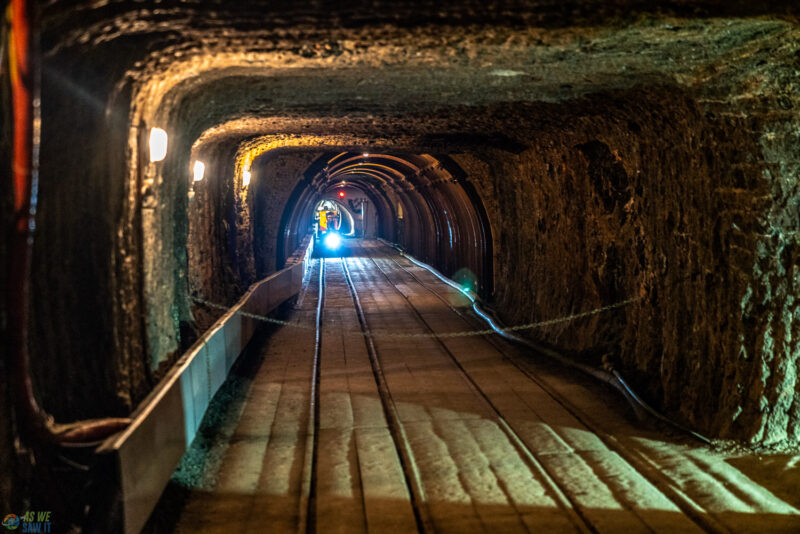
One of the highlights of our second day was touring the Hallstatt Salt Mine. Salt is the reason Hallstatt became important in the first place, and people have been mining it here for thousands of years.
Before entering the mine, we changed into miners’ clothing and followed our guide underground through the tunnels and exhibits. It’s one thing to read about Hallstatt’s salt-mining history in the museum; it’s another to actually go inside the mountain where it happened.
And then there were the miners’ slides.
They were once a practical way for miners to get from one level of the mine to another. Today, visitors get to try them too—and yes, we did.
The mine has been substantially rebuilt since our visit, so today’s experience isn’t exactly the one shown in our photos. The current tour still takes visitors underground and includes the miners’ slides.
Hours: Tours normally begin at 9:30 am during the winter operating period, with the final guided tour at 3:00 pm. Allow plenty of time for the whole experience; this is not a quick pop-in attraction.
Have coffee at the Rudolfsturm Restaurant
We stopped at Rudolfsturm for coffee before heading down. By then we’d spent a good chunk of the day outside in the winter cold, and wrapping our hands around something hot felt pretty wonderful.
The historic tower sits beside the Skywalk, with lovely views over Hallstatt, the lake, and the surrounding mountains. The view was certainly part of the attraction, but so was the hot coffee.
We stayed just long enough to warm up, enjoy the view, and give our feet a break before making our way back down the mountain.
Time for supper.
Hours: Rudolfsturm is open daily while the funicular is running, generally from 10:00 am until late afternoon in winter. The last downhill funicular currently leaves at 4:30 pm.
Enjoy dinner at Brau-Gasthof Restaurant
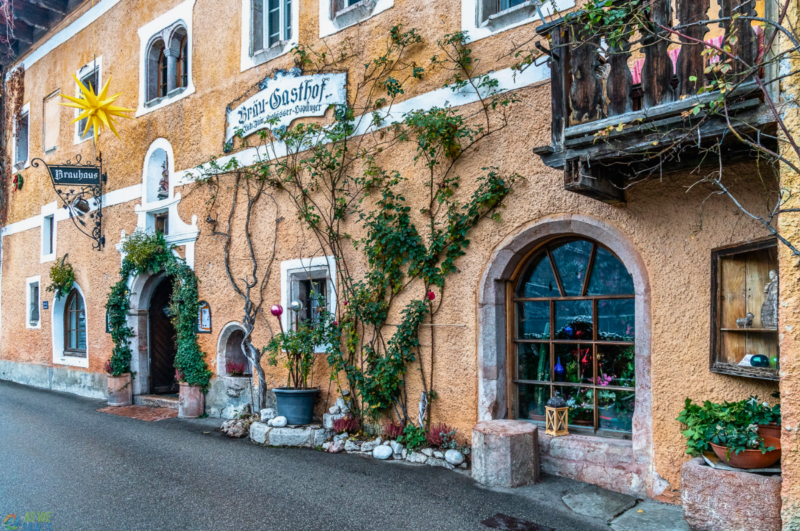
After a long day of touring Hallstatt, we were certainly ready for something a little special.
We headed to Bräugasthof Hallstatt, a traditional inn in a centuries-old building right on Lake Hallstatt.
The restaurant has old brewery vaults and wood-paneled rooms, and the menu focuses on Austrian food. Fresh fish from Lake Hallstatt is one of the specialties.
By that point, we’d spent the day photographing Hallstatt from every conceivable angle, looking at painted skulls, wandering through museum exhibits, climbing steep streets, heading up the Salzberg, touring an underground mine, and sliding down wooden miners’ slides.
We were hungry, and this tasty hot dinner really hit the spot. Then, we headed back to our hotel, fully satisfied with the two days we’d spent in Hallstatt.
Hours: Bräugasthof closes in November and reopens in early December for the Christmas and New Year period. It’s closed Mondays and Tuesdays in winter and may also take a company holiday in late winter.
What to pack for a Hallstatt winter trip
Here’s what I’d pack:
- Coat – Preferably something wind-resistant with a hood. You’ll spend plenty of time outdoors and standing still for photos.
- Fleece-lined thermals – They add warmth without making it hard to move.
- A beanie or warm hat – Get one that covers your ears. Cold mountain air has an uncanny ability to find whatever part of you forgot to cover.
- Gloves – Warm gloves are a must. If you use your phone a lot for photos or directions, touchscreen gloves save you from having to peel them off every five minutes.
For everything else, see our winter packing list for Europe.
Is Hallstatt worth visiting in winter?
I think so.
Just don’t arrive expecting Hallstatt to look exactly like every snow-covered photo you’ve seen online.
We saw the village in both snowy and mostly snow-free conditions during our visit, and it was beautiful either way. Even when there wasn’t much snow down at lake level, the mountains around Hallstatt still looked wonderfully wintry.
And there’s something to be said for staying overnight rather than rushing through on a day trip.
We had time to wander the streets, stop for meals, photograph the village after dark, see the churches and Bonehouse, spend time in the museum, and explore some of the viewpoints without constantly checking the time for the trip back to Salzburg or Vienna.
On Day 2, we also had enough time to head up the Salzberg, walk out onto the Skywalk, tour the Salt Mine, stop for coffee at Rudolfsturm, and still come back down for dinner in Hallstatt.
For us, two days was the right amount of time. We got to see Hallstatt rather than simply arrive, photograph it, and leave.
💡 Want more winter trip ideas?
In the U.S., we’ve covered the best New England winter getaways, things to do in NYC in winter, warm winter vacations in the USA, and the top day trips from Orlando and Miami.
For Europe, there are the best European Christmas markets, Christmas in Crete, and places to visit in Europe in December. We also have cold-weather guides to Vienna, Munich, Salzburg, Hallstatt, Zagreb, and Ljubljana, plus a winter packing list and a guide to European Christmas food traditions to try.
For winter in the Southern Hemisphere, we’ve covered the best ski resorts in Australia.