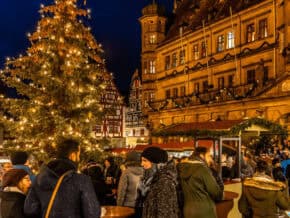
We went to Zagreb in winter for the Christmas markets, but the city gave us plenty to do between mugs of mulled wine. Its historic center is compact, most of the main sights are walkable, and two days is enough time to explore both the grand Lower Town and the much older streets of Gradec and Kaptol.
This 2-day Zagreb winter itinerary follows the route we took through the city, with the stops arranged so you’re not zigzagging all over town.
Day 1: Zagreb’s Lower City

Start your first morning in Zagreb’s Lower Town, where grand squares, parks, and some of the city’s most important buildings sit close together.
Explore Republic of Croatia Square (Trg Republike Hrvatske)

Republic of Croatia Square is one of Zagreb’s grandest public spaces. The Croatian National Theatre sits at its center, with the University of Zagreb and several other important cultural and educational buildings around the square.
Until 2017, this was Marshal Tito Square, so you may still see the old name in older guidebooks and articles. The square began taking its present form in the mid-19th century and is now one of the main architectural set pieces of Zagreb’s Lower Town.
Take a few minutes to walk around the square before moving on. Even in winter, the formal gardens and surrounding historic buildings make this one of the better places to stop and get a sense of how polished this part of Zagreb feels.
Croatian National Theater

One of the most imposing buildings on the square is the Croatian National Theater. Commonly referred to as HNK Zagreb, it’s home to world-class ballet, opera, and drama performances.
Even if you aren’t a fan of the arts, the building itself is certainly worth the visit. This striking neo-baroque masterpiece dates back to 1895, making it an amazing sight. With its yellow walls, columns, flag turrets, and fine details, you can easily appreciate the great architectural work behind this building.
The Spring of Life

Directly in front of the theater is a bronze statue called The Spring of Life. Also known as the Well of Life, this famous sculpture is actually one of the most well-known landmarks in Zagreb’s Lower city.
The sculpture depicts ten naked figures circled around a well full of water. As these figures are all in different stages of their lives, the well symbolizes life and youth. It is actually thought of as the source of eternal beauty.
The Spring of Life was crafted by the Croatian sculptor Ivan Mestrovic in 1905. This is a must-see artwork in Zagreb.
Visit The University of Zagreb

Just across the street from the square is the University of Zagreb, Croatia’s largest university and one of the oldest in this part of Europe. Founded in 1669, it’s the oldest continuously operating university in Southeastern Europe.
The main university building faces Republic of Croatia Square, so there’s no detour involved. Take a look at the historic façade and grounds before continuing toward Zrinjevac Park.
The university now has more than 30 faculties and three academies.
Enjoy Zrinjevac Park

From the university, follow Masarykova Street – which becomes Testlina Street – and arrive at Zrinjevac Park.
Zrinjevac is a popular place amongst the Zagreb locals, and there is always something fun happening. You’ll find art installations, live concerts and events when you spend some time around here.
Highlights of the park include a historic 19th-century music pavilion that’s also a famous open-air concert stage. There are also numerous fountains in the park, including Zagreb’s oldest fountain (dating back to 1878).
In warmer weather, Zrinjevac Park is one of the most romantic and relaxing destinations to visit in Zagreb. It makes such a peaceful escape from the city surrounds, with stunning trees, lawns, and flower beds.
Unfortunately, you won’t have many flowers to appreciate at this time of year. That said, if your visit coincides with Advent in Zagreb, then you’re in luck. Zrinjevac has long been part of Zagreb’s Advent celebrations, when the park’s 220 plane trees are brilliantly lit for the season and holiday events take over around the old music pavilion. That’s also when you’ll find food and drink booths around the park. Check the official Advent program to see what’s happening there during your visit.
Year-round, the park is free to visit.
King Tomislav Square

After walking through all three blocks of Zrinjevac Park, you will end up at the impressive King Tomislav Square. This elegant square in the middle of the city is surrounded by even more important buildings.
There’s a beautiful 19th century Art Pavilion at the northern end of the square. Normally an important venue for art exhibitions in Zagreb, the pavilion is currently closed while the earthquake-damaged building is renovated. The other end of King Tomislav Square is bordered by the main train station. A grand statue of King Tomislav on horseback can be found at the center of the square.
Day 2: Zagreb Upper City walking tour
Yesterday was all about seeing the Lower City. Today we explore the historic Upper City, which is considered the historical nucleus of Zagreb.
During the Advent season, Zagreb’s Christmas Markets spread through both the Lower and Upper City. We actually visited Zagreb to see its world-renowned Christmas markets, so you’ll pass several Advent locations along today’s route.
Start at the Zagreb Funicular

Start at the lower station of the Zagreb Funicular on Tomićeva Street, just off Ilica. Opened in 1890, this steep little funicular connects Zagreb’s Lower and Upper Towns.
And when I say little, I mean it. The track is only 66 meters long, making this the shortest public-transport funicular in the world. The entire trip takes 64 seconds.
Take the funicular up to Strossmayer Promenade. It leaves every 10 minutes, and the upper station puts you practically next door to Lotrscak Tower.
See the city views from Lotrscak Tower

Lotrscak Tower is just a short walk from the Funicular, so it’s an easy first stop in Zagreb’s Upper Town.
The tower dates back to the 13th century, when it guarded the southern gate in the walls around Gradec. We climbed to the top, where the view makes it much easier to get your bearings. From up there, we could look across Zagreb’s rooftops and over toward St. Mark’s Church, with the Lower Town spread out beyond the old city.
If you’re here at noon, brace yourself. The Grič cannon has been announcing 12 o’clock from Lotrščak Tower since 1877, and it is not subtle.
From Lotrscak Tower, walk east along Strossmayer Promenade, then turn left onto Ćirilometodska Street. Follow it straight to St. Mark’s Square.
Admire St. Mark’s Church

St. Mark’s Church is famous for its colorful tiled roof. This old church is another of the city’s great 13th-century buildings. Its tiles depict the medieval coat of arms of Croatia, Dalmatia, and Slavonia on one side, and the emblem of Zagreb on the other.
Don’t stop at the roof, though. Walk around to the south side and take a look at the Gothic portal, where 15 carved figures sit above the entrance. It’s one of the most elaborate medieval portals in Croatia.
St. Mark’s doesn’t keep regular sightseeing hours, so don’t count on walking in during the day. Your best chance to see the interior is to attend Mass or catch one of the occasional special openings.
- Mass: 18:00 on weekdays; 11:00 and 18:00 on Sundays, holidays and feast days. During Advent, there is also a 6:30 dawn Mass Monday–Saturday.
When you’re finished in the square, take Kamenita Street and follow it downhill to Stone Gate.
Experience Croatian traditions at Stone Gate

Stone Gate is the eastern gate of medieval Gradec and the only one of the old city gates still standing. Dating from the 13th century, it once controlled access into the fortified town.
In 1731, a huge fire swept through the Upper Town and burned Stone Gate. A painting of the Virgin Mary that had been hanging at the gate was found in the ashes afterward, supposedly untouched even though its wooden frame had burned.
The widow who found it had a small altar built for the painting under the gate’s arch. That shrine is still here today, and you’ll usually see candles burning while people stop to pray or give thanks.
Pass through the gate and continue downhill toward Tkalčićeva Street.
Walk Down Ulica Ivana Tkalcica

From the famous Stone Gate, you can take a stroll down Ulica Ivana Tkalcica. This pedestrian street follows the route of the stream that once separated Gradec from neighboring Kaptol. For centuries, it was literally the dividing line between the two settlements—and considering how often the two sides fought, that stream had a lot of work to do.
Today, Tkalciceva is considerably more peaceful. The old buildings are now filled with cafes, restaurants, and shops, making this a good place to stop for coffee or lunch if you need a break. Locals usually shorten its tongue-twisting name to “Tkalča.”
Follow Tkalciceva toward its southern end, then make your way over to Kaptol Square.
Marvel at the Cathedral of Zagreb

Back down Ulica Ivana Tkalcica, you will reach Kaptol Square, where Zagreb Cathedral dominates the skyline. The Zagreb Cathedral of the Assumption of the Blessed Virgin Mary is a neo-Gothic landmark dedicated to the Assumption of Mary and to kings Saint Stephen and Saint Ladislaus. It is also the final resting place of several important Croatian figures and martyrs.
Unfortunately, the cathedral suffered serious damage in Zagreb’s 2020 earthquakes, and restoration work is still underway.
When we visited, its interior was a memorable mix of everything from Baroque marble altars to chandeliers from a Las Vegas casino and the glass tomb of a Cardinal, lying in state in all his vestments. (He was convicted of treason by the communist Yugoslav government and was beatified by Pope John Paul II.)

Two other remarkable sights in the cathedral:
- One of the side altars contains a splendid fifteenth century triptych by Albrecht Durer titled “Golgotha.”
- One of the world’s most impressive organs, classified among the top ten finest and top-quality organs in the world. It has more than 6,000 pipes, seventy-eight registers, and four manuals.
The cathedral has reopened for visits and prayer, although the ongoing work may affect what you can access.
- Open for visits and prayer: 8:00-19:00 daily
Continue south along Kaptol to Ban Josip Jelacic Square.
See the sights in Ban Josip Jelacic Square

Ban Josip Jelacic Square is Zagreb’s main central square and one of the city’s busiest meeting places.
Take note of the statue in the middle of the square, portraying Count Josip Jelacic on his horse – the man that the square is named after. He was an army general and Ban of Croatia in the mid-1800s, remembered for his military campaigns and for abolishing serfdom in Croatia.
The square is surrounded by cafes, shops, restaurants, and some beautiful old buildings. Locals have two wonderfully specific meeting places here: “under the clock” on the west side and “under the horse’s tail” beneath Jelacic’s statue.
It’s particularly lively at night when everything is lit up, and during Advent the square becomes one of the central gathering places for Zagreb’s Christmas celebrations.
💡 TIP: To explore some of the top sights in Zagreb after dark, check out this awesome Medieval Zagreb Night Tour.
When we visited, we also went up Zagreb 360, an observation deck on the 16th floor of the skyscraper beside Ban Josip Jelacic Square. It gave us great views over the square, Cathedral, Upper and Lower Town, and Zagreb’s many streets and parks. Okay, it was actually 270 degrees, since you could only go on three sides.
There was also a cafe up there, so we could sit down and enjoy the view for a while. Unfortunately, Zagreb 360 has been listed as “temporarily closed” since 2020, which seems a bit optimistic at this point.
Walk down Bloody Bridge

Bloody Bridge, otherwise known as Krvavi Most, sounds considerably more dramatic than it looks today. It isn’t even a bridge anymore – it’s now a short street.
But its name comes from a long and violent past.
The old bridge crossed the stream separating Gradec and Kaptol, and this was where disputes between the two settlements sometimes turned bloody. The attacks began in the 14th century and continued all the way into the 18th century.
There are plenty of dark stories and secrets tied to this little stretch of Zagreb. Eventually the stream was covered over and the bridge disappeared, but the street kept the name Bloody Bridge.
It’s a fitting place to end the walk, because you’ve spent much of the day exploring the same two medieval settlements that spent centuries fighting each other.
Zagreb weather in the winter
If you are visiting Croatia in December for the Christmas markets, snow is certainly possible, but don’t count on it.
Winter temperatures hover close to freezing. Long-term averages for Zagreb are about 36°F (2.2°C) in December, 33°F (0.6°C) in January, and 37°F (2.8°C) in February.
A Croatia winter will have you wrapped up in winter clothes, but the cold is usually manageable enough that you can still spend plenty of time walking around the city.

Click here to preview your posts with PRO themes ››
Where to stay in Zagreb
Zagreb’s historic center is compact enough that location matters more than hotel category. If you want to stay within easy walking distance of most of this itinerary, focus on the Lower Town, Upper Town, or Kaptol.
- Lower Town – Best for first-time visitors and the easiest access to most of the sights on this itinerary.
- Upper Town – Best if you want to stay in the oldest part of the city, close to St. Mark’s Church, Stone Gate, and Lotrscak Tower.
- Kaptol – A convenient option near Zagreb Cathedral and Tkalciceva Street, with some good-value places to stay.
Most of the sights in this itinerary are close enough to walk between. Zagreb also has an affordable public transportation system, so staying a little farther out isn’t a dealbreaker.
Final thoughts about Zagreb in winter

We did a Zagreb winter trip because of its Christmas markets, but the city itself ended up being just as interesting. In two days, we walked from the grand squares of the Lower Town into medieval Gradec and Kaptol, climbed Lotrscak Tower, ducked through Stone Gate, wandered Tkalciceva, and saw just how much history is packed into a fairly compact city center.
Winter worked especially well for this trip because Zagreb is so easy to explore on foot. Yes, it was cold, but we could walk almost everywhere on this itinerary, stopping for coffee, food, or something hot from an Advent stall whenever we needed to warm up.
If you’re already considering Croatia in winter, don’t treat Zagreb as somewhere to fly into and immediately leave. Give it a couple of days.
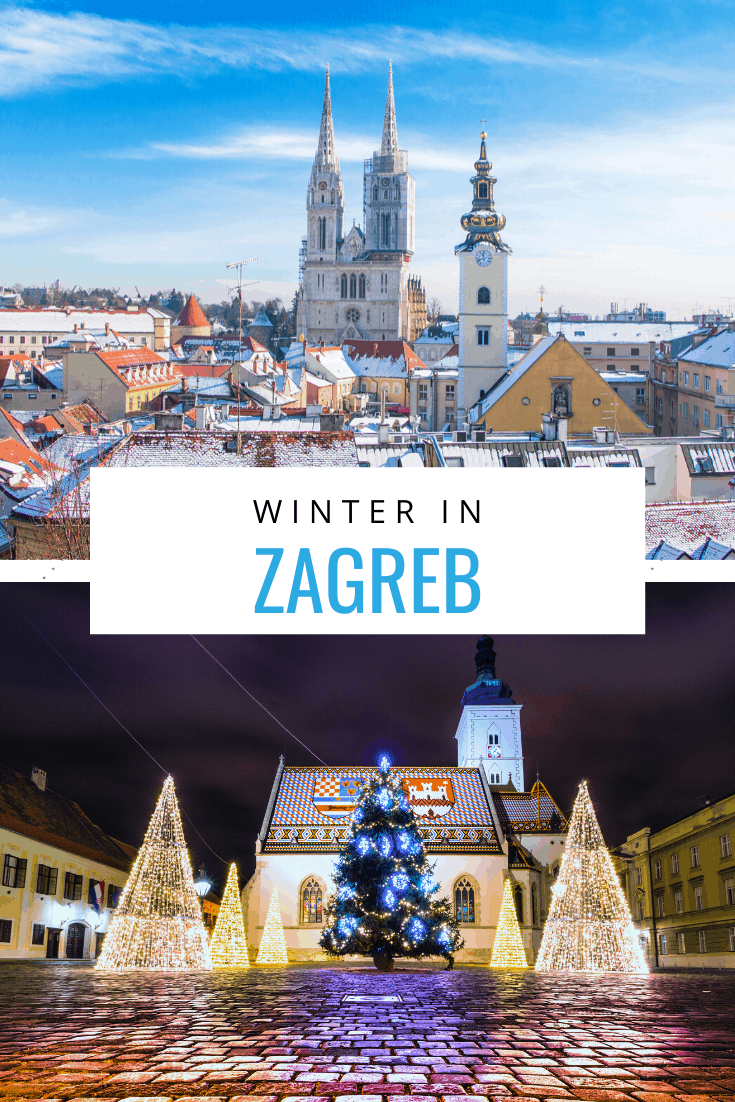
Inspired? Pin this post and save it for later!
💡 Want more winter trip ideas?
In the U.S., we’ve covered the best New England winter getaways, things to do in NYC in winter, warm winter vacations in the USA, and the top day trips from Orlando and Miami.
For Europe, there are the best European Christmas markets, Christmas in Crete, and places to visit in Europe in December. We also have cold-weather guides to Vienna, Munich, Salzburg, Hallstatt, Zagreb, and Ljubljana, plus a winter packing list and a guide to European Christmas food traditions to try.
For winter in the Southern Hemisphere, we’ve covered the best ski resorts in Australia.