
Is there anything actually worth doing in Civitavecchia cruise port? After spending two nights here before our Mediterranean cruise, we walked away with a surprising answer: yes—if you know where to look.
Most cruise passengers only see the industrial port terminal and assume there’s nothing here. But a 10-minute walk from the port, you’ll find a medieval fortress, waterfront promenades, and locals-only trattorias serving fresh seafood—no tour bus crowds in sight.
Whether you’re arriving early to avoid flight delays (like we did), have a few hours before embarkation, or are skipping the Rome day trip during a port call, this guide covers the best places to see plus practical details on where to stay and how to get around Civitavecchia.
Here’s what’s actually worth your time.
At a Glance: What to Do in Civitavecchia from a Cruise Ship
Updated February 2026 — hours, transport details, and tips checked.
| Your Goal | Best Option | Why |
|---|---|---|
| Walkable sights near the port | Forte Michelangelo, the promenade | Easy, free, close to shuttle drop-off |
| Local food without crowds | Mercato di Civitavecchia or seaside trattorias | Fresh seafood, authentic atmosphere |
| History & culture | National Archaeological Museum | Compact, well-curated, quick visit |
| Beaches | Il Pirgo or Lido | Simple access, good for short stays |
| Ancient ruins | Terme Taurine | Unique Roman site, taxi needed |
| DIY Rome | Train from Civitavecchia → Roma Termini | Fastest, most flexible route |
| Skip-the-line Vatican or Rome highlights | Guided tour | Reliable timing for cruise schedules |
💡 PRO TIP: If you’ll be visiting Rome for a few days, be sure to check out the helpful travel planning links at the end of this article.
How to Get Around Civitavecchia (Cruise Port Logistics)
The port shuttle drops everyone at Largo della Pace, the main entry point into town.
Civitavecchia is compact and easy to navigate on foot. From the port shuttle drop-off, everything in this guide is walkable. For anything outside the center—like Terme Taurine, the train station, or beaches—you’ll use taxis, trains, or a guided tour.
- If you’re heading to the station, here’s the exact route: How to Get from Civitavecchia Port to the Train Station.
- Planning to see Rome on your own? Check out our guide to Rome in One Day from a Cruise Ship.
Is Civitavecchia Worth Visiting? (Short Answer: Yes)
Civitavecchia may seem little more than a gateway to Rome, but this historic port city warrants a closer look.
A lot of cruisers choose spending a day in port over dealing with the noise and chaos of Rome. Fortunately, there are lots of things to do in and around Civitavecchia, so there’s no need to rush for the next train bound for the Eternal City.
Here’s what to do in this ancient maritime city—which, by the way, is pronounced chee-vee-ta-VEK-ee-ya.
Civitavecchia Walking Tour (Self-Guided Route You Can Do from the Port)
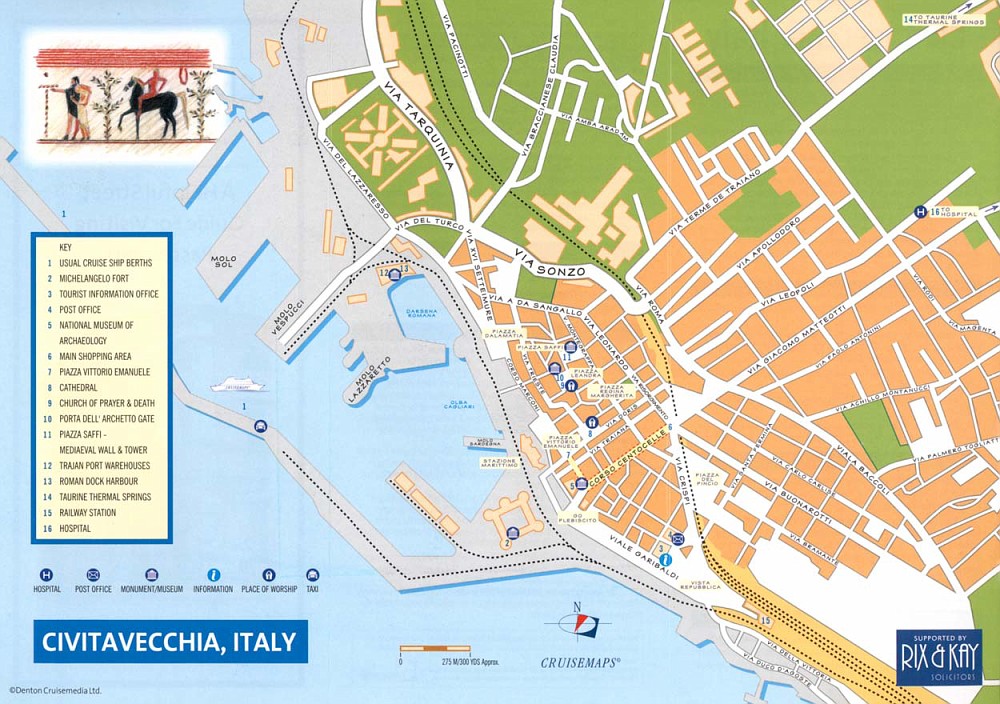
Civitavecchia offers complimentary tourist maps that highlight the main sights and offer a few walking tour itineraries. They are available in both Italian and English at any of the port’s information desks, as well as in many hotels. Alternatively, you can download the Civitavecchia tourist map here.
Since we were unable to decide on an itinerary, we decided to create our own by combining them all over dinner. Before our meal was over, we had a map full of lines and a day to look forward to.
Follow along, and we’ll walk you through the best things to do in Civitavecchia, as we saw it.
Stop 1. Il Ghetto di Civitavecchia (Historic Jewish Quarter)

Pope Innocent XII built the ghetto at the end of the 17th century to host the Jews… who never came. With all its old buildings, Civitavecchia’s not-so-Jewish ghetto is picturesque and full of life, yet it’s an area where we saw relatively few tourists. I guess they were hanging out along the waterfront or near the port.
“Il Ghetto” became our go-to spot for food, especially the area around Piazza Fratelli. Over the years, we’ve discovered that restaurants that attract local patrons tend to offer more reasonable prices. So naturally, we ate two dinners and one lunch there.
Whenever we entered and were greeted in Italian, we knew that this spot catered to locals, rather than tourists. The best thing about this is that you will get authentic flavors, cooked by a chef who cares about getting repeat customers.
Italians eat dinner after 7:30 and take all evening socializing over their meals, so we arrived earlier. It was the easiest way to ensure we would find an available table.
ⓘ TIP: Always opt for the most crowded restaurant when you can. Sure, you may wait to be seated, but a busy eatery is a positive indication that the locals enjoy the food.
Stop 2. Corso Centocelle (Main Shopping Street)

Not far from the shuttle terminal is a pedestrian walkway called Corso Centocelle. It is usually crowded with tourists spending their shore time in its numerous shops, buskers hoping for a tip, and quality al fresco dining.
While modernizing the street, the construction crew discovered several Etruscan ruins buried under the pavement. The ruins are on display under glass here and there along the walkway. So, watch your step while you’re walking, and you may discover a treat underfoot!
The Trajan Municipal Theater is a landmark on the street. Named after Emperor Trajan, who founded the city, it features a neoclassical façade dating back to the early 1800s. The building was fully restored and modernized in 1999, and its auditorium now accommodates nearly 650 guests.
ⓘ TIP: If you enjoy events and shows, check the playbill to see what is going on for the evening. The theater offers both local and international entertainment.
Stop 3. Piazza Regina Margherita

The walkway ends at Piazza San Margherita, a town square best known for Mercato di San Lorenzo, Civitavecchia’s traditional market. It’s fun to wander through local markets to see what appeals to the locals.
As with most local markets, you can usually find something new to try. We purchased a variety of new-to-us cheeses to snack on, then went off in search of the fish market that our desk clerk had recommended. He forgot to mention that they are only open in the mornings. By the time we got there, they were already closing up, but a few stalls were still doing a brisk business to latecomers.
Exiting on the other side, we found the meat market. Just so you know, they offer a variety of meats—even horse. Yuck.

Stop 4. Chiesa della Stella
Chiesa della Stella church is the starting point of Civitavecchia’s traditional Good Friday procession. The entire town participates in this annual event. It’s a big deal, so don’t miss it if you’re in town on Good Friday.
Inside, you’ll find frescoes by a local artist, a valuable wooden crucifix from the 1700s, and a statue of Our Lady of Mercy. That is, if you can get inside. It was locked up tight when we were there.

Stop 5. Piazza Leandra (Oldest Square in Civitavecchia)

Civitavecchia’s historic center, Centro Storico, is almost completely free of tourists. This makes for some lovely atmospheric shots. Ancient Piazza Leandra enchanted us with all its well-trod cobbles, weathered homes, and laundry hung out to dry.
We also spotted a weathered stone tower gate, sandwiched between two old houses. Quite obviously, it had been part of Civitavecchia’s original wall. Venturing through its passageway, you’ll find that you’ve descended to a lower level on the far side. The stone wall can still be seen on this lower level. Shop and building entrances haven’t changed much over the centuries. Kind of cool!

Stop 6. Santa Maria dell’Orazione e Morte (Baroque Church)

Our map called Santa Maria dell’Orazione e Morte “a true Roman basilica in miniature.” Dating from the late 1700s, it has an elegant elliptical shape and a dome, which was painted by Giuseppe Errante.
Like many others in town, this Baroque church has beautiful frescoes. However, it is probably the only church that has a balustrade from the stern of a boat inside, and that is what it is best known for. It is also home to a wooden statue of the resurrected Christ, which they carry in the Easter Procession.
Stop 7. Darsena Romana (Old Harbor Area)

The Roman dock that was built back in Trajan’s day still exists. Not much else from that era has survived, though, because Civitavecchia was almost completely destroyed during World War II.
Stop 8. La Rocca and Il Lazaretto

Our map mentioned two older structures: the “La Rocca” fortress, and “Il Lazaretto,” a hospital for contagious diseases. Like the rest of Civitavecchia, both suffered severe bomb damage during World War II, so not much of them remains.
That map was misleading; Both buildings are way the heck out on the edge of the water and hard to get to. We were thwarted by fences, detours, and dead ends, and once we finally reached the perimeter, we couldn’t find any way to sneak in. The buildings may be in ruins, but the fences seem to be carefully maintained. Dangit.
Don’t waste your time trying to get there. To be honest, you can probably see them better from your ship.
Stop 9. Principe Tommaso promenade

So, back we went to the mainland, through the harbor and marina, and came to the “Principe Tommaso” promenade and a 17th-century defense wall that was built by Gian Lorenzo Bernini.
Yes, that Bernini. You know, the same person who designed St. Peter’s Basilica? It might seem surprising that such a famous artist would deign to design a mundane city wall… until you learn why he did it.
As I understand it, Pope Urban VIII was concerned about enemy invasions and wanted to protect the city from naval attacks, so he called in Bernini to do the job. One does not refuse the Vicar of Christ on Earth.
Stop 10. Fountain of Vanvitelli
There’s a beautiful travertine fountain in the center of the wall, with water coming out of the mouth of a faun. Pope Benedict XIV commissioned the fountain in 1740, and it’s the only piece of artwork on the entire wall.
The fountain was named for its designer, Luigi Vanvitelli. Few think of visiting it these days, but it used to be a meeting place for the locals.

Stop 11. Forte Michelangelo (Civitavecchia’s Landmark Fortress)

Forte Michelangelo is Civitavecchia’s most imposing building, which makes it a convenient drop-off point for cruise ship shuttle buses. The fortress has 6-meter-thick walls and is still in perfect condition. The only thing that’s lacking is the moat that once surrounded it.
Forte Michelangelo was commissioned by Pope Giulio II in the early 1500s and earned its name because Michelangelo had designed its central tower. Like all other forts, it has a central courtyard.
The building was severely damaged from bombings during World War II. They restored it in the 1950s and it’s now used for exhibitions and cultural events.
The fort’s dramatic entryway fooled us into thinking that it was a tourist attraction, and we walked through the old entrance expecting to pay an admission fee. The place was completely deserted, and all we got to see was the courtyard and the bronze pulley that was once used to lower and raise the bridge.
Nothing to see here. Move along.
💡 PRO TIP: We later learned that the National Archaeological Museum of Civitavecchia is just steps from Fort Michelangelo—at Largo Camillo Benso Conte di Cavour, 1. It’s easy to miss, but worth a quick stop for Etruscan and Roman artifacts spanning prehistoric times to the Middle Ages. Most displays have English translations. Open Tue–Sun, 8:30 AM–7:30 PM. Admission €3.
Stop 12. St. Francis of Assisi Cathedral
So we turned back the way we’d come, dodging clusters of cruise passengers who were far more focused on souvenir kiosks and gelato stands than checking out the things to see in Civitavecchia. Our real destination was the Cathedral in Piazza Vittorio Emanuele II. We’d read that it housed a fresco depicting St. Francis receiving the stigmata, and, well—when we hear something like that, we go look.
No luck there, either. The doors were flat-out locked. No visitors. No glancing inside.
But right outside in the piazza stood the Fallen Soldiers Monument—hard to miss, and thankfully very much open-air. It ended up being the one thing we could actually take in at this stop. Sometimes the most interesting parts of a port town are the ones you find outside the plan, not on it.

Stop 13. Civitavecchia waterfront
So much for roaming the Centro Storico. Time to pivot toward the sea and see what the waterfront had waiting for us.
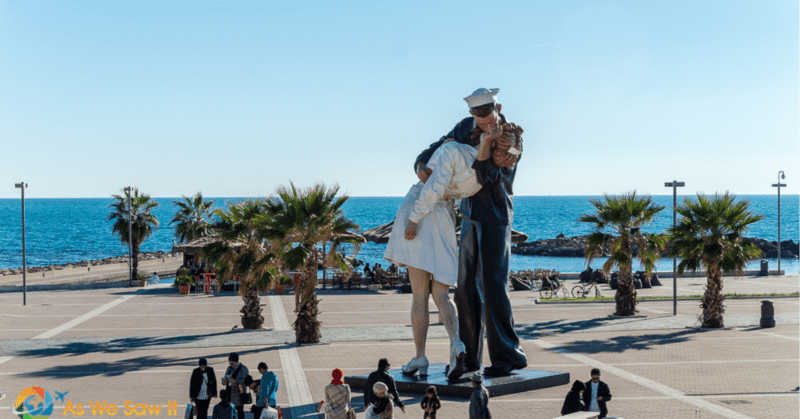
No one can miss the colorful, oversized “Unconditional Surrender” sculpture of a Navy sailor kissing a nurse along the seaside promenade. It’s inspired by Alfred Eisenstaedt iconic 1945 photograph taken in Times Square when the end of World War II was announced—one of those rare moments captured at exactly the right second.
A steady breeze and calm ocean waves beckoned us to the water’s edge, where fishermen angled for a bite. We sat for a bit near the edge, watching them cast and reel, cast and reel.

As the sun dropped lower, we strolled the full stretch of the promenade, savoring the relative peace and quiet away from the cruise crowds. But the beachfront here was disappointing. The shoreline is mostly smooth pebbles, not the sandy sprawl you picture when someone says Italy beach day.
For a day in the sun, the beach is probably worth visiting, though you’ll need to walk a few yards inland to find soft sand that’s comfy enough to lie on. But don’t bother walking to the far end to check out the pier—it looks better from a distance.
When we finally saw it up close, it was all graffiti-splashed concrete, faded paint, and fishing gear parked in the sun. Still, there are a couple of places to stop in for a drink—if you enjoy hanging out among locals.
ⓘ TIP: Late afternoon is aperitivo time! We suggest entering a bar to join other Italians and enjoy a glass of wine (or something more to your liking). Maybe try a refreshing Aperol Spritz; it’s one of the most popular cocktails in Italy.
What We Learned After Spending Time in Civitavecchia
Looking back, there are a couple of things we would have done differently with more time in Civitavecchia. Both of us love ancient history, and this area is packed with Etruscan sites. Tarquinia—just up the coast—is a UNESCO World Heritage site with painted tombs and archaeological trails. It’s the kind of place we normally never skip, and I still wish we’d carved out a few hours to go.
Another thing we should have done was purchase a cruise ports travel guide beforehand. A good one costs around $20-$30 and would’ve been worth it—for all the practical tips and the non-touristy spots we had to find the hard way. Plus, we would have learned more about every stop!
Even so, we enjoyed wandering around Civitavecchia. It’s one of those places that’s more interesting than it looks on paper, and spending time here always gives you a better feel for Italy before the cruise rush begins.
Civitavecchia History: Why This Port Matters

Civitavecchia has deep roots stretching back to the Etruscan civilization. Being strategically located on the shores of the Tyrrhenian Sea, it was the perfect spot for oceangoers long before the Romans arrived.
In 106 AD, Emperor Trajan transformed the area by constructing an impressive artificial harbor. He named it Centumcellae (meaning “hundred rooms” or “hundred basins”), likely referring to the numerous vaulted warehouse chambers built along the harbor front.
The port thrived under Trajan’s vision. It reached its peak during the Roman imperial period and became a vital maritime gateway for Rome.
Even today, 2000 years later, Civitavecchia continues to be the primary docking point for all major cruise ships and ferries headed to the Eternal City.Day Trips from Civitavecchia (If You Don’t Want to Stay in Town)
If you don’t want to spend your entire day in Civitavecchia or on the ship, there are really two alternatives: head into Rome, or choose a day trip that stays outside the city altogether.
Most organized excursions from Civitavecchia run about 4–8 hours and include transportation directly from the cruise port. This simplifies things if you’d rather not manage logistics on your own and want to make sure you’ll get back to the ship before it sails.
- Head into Rome.
Start here if you’re trying to decide whether Rome is realistic from the cruise port, how to get there, and how much time you’ll actually have: How to See Rome on Your Own from Civitavecchia Cruise Port - Narrow your focus once you’ve chosen Rome
If Rome makes sense for your day, this comparison helps you decide how to spend limited time once you’re there: What to Choose on a Rome Cruise: Colosseum or Vatican - Skip Rome entirely
If you’ve already visited Rome — or simply want something closer to the port — this guide covers non-Rome day trips such as coastal towns, hill towns, and nearby wine regions: Best Cruise Excursions from Civitavecchia Besides Rome
When to Arrive in Civitavecchia for Your Cruise (Most Travelers Get This Wrong)
We strongly advise against arriving in port the day of your cruise departure. Flights into Fiumicino are often delayed, the transfer to Civitavecchia can easily get backed up by traffic, and Italy’s frequent train strikes can halt transportation altogether. If anything goes wrong, the ship won’t wait — and you’d have to catch up at the next port at your own expense.
If you don’t want to be a ball of nerves the day of your cruise, it’s best to arrive a day or two in advance. It gives you time to settle in, adjust to the time change, and actually enjoy the city’s culture, attractions, and restaurants before boarding your ship.
For us, two days was perfect. Being such an ancient town, we thought it would be fun to get away from the tourist areas and see if we could find any old walls or buildings. We also wanted to know if there were any things to do in Civitavecchia that would be fun for people who weren’t going on a cruise. And that’s how this article was born.
💡 PRO TIP: We stayed at Hotel De La Ville, a large 19th-century mansion-turned-hotel. It overlooks the waterfront and is only 100 yards from the train station.
Practical Civitavecchia Travel Tips (Where to Stay, Timing, Local Advice)
Currency: Italy uses the Euro. This website will help you calculate exact currency exchange values.
Layout: Google’s satellite photo map gives a clear aerial overview of Civitavecchia’s waterfront. You can see Forte Michelangelo and the port entrance on the left, with the main waterfront promenade along the beaches and the railroad station on the right.
How to Get to Civitavecchia Port from Rome
Civitavecchia is on the western coast of Italy, about 80 km (50 miles) northwest of Rome and straight up the coast from the airport.
- From the airport: The Leonardo Express train goes to Termini Station in Rome, where you can take an express train to Civitavecchia. Alternatively, there’s a dedicated shuttle bus that can take you from the airport to the cruise port.
- From Termini train station: Trains run from Termini to Civitavecchia regularly—both local and express. There is also a shuttle bus outside the train station that will drop you off at the port.
- From anywhere in Rome: You can book a private transfer from Rome (airport or hotel) directly to your ship.
This article explains how to get to the port from the train station.
💡 PRO TIP: Civitavecchia’s Tourist Information Office is next to the port’s south entrance. Head here to pick up a city map, ask questions, and get directions.
Final Thoughts on Visiting Civitavecchia
Civitavecchia is more than just a stop on your way to Rome; it’s an adventure waiting to happen! With its fascinating history, mouthwatering cuisine, and picturesque scenery, this port city deserves your time and attention.
So why not take a detour? You’ll leave with unforgettable memories and maybe even a newfound love for this hidden treasure!
My wife and I just spent a half day walking around Civitavecchia during a cruise stopover here, instead of taking a shore trip to Rome, and really enjoyed the town and the market. Your post on Civitavecchia was really helpful to us in giving some background on some of the sights here.
Gee, thanks, Pete! It means a lot to get feedback like this. We’re so glad our post was so helpful – it took a lot of work to put together. 🙂
Hi, I’m going to cititavecchia soon, can you tell me if you can get a taxi from port to the shops, and how much.
Hi Clare, you won’t need a taxi. The port has a free shuttle that runs between the ships and the front gate. From there, Civitavecchia’s shops (and all the things to do that we talked about in this post) are literally steps away.
Running into an issue. didn’t realize the port was that far away from Rome. I have never been to Rome, but in reality I have never been to Europe. We are leaving on a cruise out of this port in May and I was wondering if you think it is easier to stay near the port and commute into Rome. Or to stay in Rome then commute out to the port on the morning of the cruise. I want to be able to look around the port town so I’m thinking maybe if we came into the area easier we could explore before we got on the ship, but that might be a hassle with all of our luggage. Looking for some ideas.
We always recommend arriving in port early because it would be horrible to miss sailing due to a rail strike or flight delay. If you have the time, we’d suggest that you spend at least 3 days in Rome (save one day for Vatican City), then spend at least one night in Civitavecchia before your cruise. You can spend your time exploring the port or on a day trip. (Here are some to consider.)
Hotels will hold luggage for guests who arrive before check-in time (a free service), so don’t worry about that.
Civitavecchia is like a lot of places around the world – it is what you make it! The majority of the locals are either extremely negative (maybe because they have never been able to “break free” from all the expectations/disappointments of family and friends) or else they have a wider view and are able
to see the beauty & history of this old city.
My wife’s family is from CV, so she has known it all her life and certainly remembers it as it was many decades ago, good and bad. It is different for me, the “straniero” of the family (from downunder) who first visited CV in 2000. I have seen the port area redeveloped from a dirty, post-industrial wreck to the vibrant, friendly and much more liveable “destination” of today.
We are fortunate to have a 3rd floor apartment overlooking the Roman Darsena and central port area with amazing views of the panorama, so are able to enjoy the port all year round.
We would strongly recommend any visitors to this part of Italy to spend a day or so in Civitavecchia.
Wow, Richard, you must have a fantastic view! I’m glad you agree that Civitavecchia is worth visiting. Would you like to share any of your favorite spots with our readers?
Thanks to you, Linda, here we are : http://www.xn--blogmaril-e5a.it/myself/
I will add some pictures of my place on the web page soon.
Them I am preparing some menus for the coming cruising season that I will post in few weeks.
At home it’s me, my husband and my daughter. Kids are more than welcome.
If you should come back to this part of the world do not hesitate to come and see me !
Have a great day.
Maria Elisa (Marilì)
We would be honored to visit you, Maria Elisa. I am sure your food is amazing.
That’s nice! if you are staying in Civitavecchia you can also have a typical Italian lunch at my home with my family. You will be immersed in an Italian family atmosphere and you can taste some delicious traditional homemade food I prepare myself. I can host a party from 1 to 6 people, the house has a very nice view on the town/ seaside and if the weather is good you can have lunch on the balcony. As a rule the meal includes some fish or meat plates but we can also prepare vegetarian and vegan meals. We have choice of italian wines and arti If you find it interesting just book the service : Maria 393351285214 Email [email protected]
Good to know, thanks for sharing. Do you have a web page as well?
after reading this i chose to go to the port 2 days before my cruise on the 23 april 2017 and stay at the same hotel.. about four years ago i saw the unconditional statue and want a relaxing time before the cruise. i am gay 62 nz guy
We’re really glad it was helpful, Stuart! How did you like the hotel?
It looks so nice, or maybe your great photos make it look beautiful! Years ago I had a romance with a boy from Civitavecchia and he told me it was horrible – his parents were born there and he had to spend a month there every summer. So I always had in my mind that it would be awful! This is a gorgeous professional-looking post. I love Lazio it has some real hidden gems.
Thanks for the compliment. It is a nice place but maybe it wasn’t quite the same back when your boyfriend spent his summers there. Judging from the condition of the cruise port it appears Civitavecchia might had a facelift in recent years.
That is so funny! I guess ‘home’ is never as interesting as it is to others!
Civitavecchia looks like my kind of destination! It’s probably due to the proximity to a body of water. 🙂 I’ve been researching on Italy and this is the first I’ve heard of it. Definitely adding this to my itinerary when I do go. 🙂
I think every place along the Italian coast would make a wonderful destination. 😀
This is certainly my kind of place to visit!
I’ve been through Civitavecchia as a cruise stop and went on to Rome for the day. Thanks for your fantastic write-up. When I make it back to this area, I will most definitely try to spend some time in this city as it has so much to offer.
I hope you do make it back, Rhonda. That might mean you are going on a cruise! 🙂
HI Linda,
Great write-up! you know, I’ve passed Civitavecchia a gazillion times- and I never bothered to stop! Now i know there’s plenty to explore and I’ll make a point of making a proper visit sometime soon. Thanks for this!
PS the comment boxes here don’t really show up on my Mac-both using Chrome and Sfarai. I hope i put the right info n the right places… if not- sorry!
You’re so welcome, Michiel. It was a real temptation to skip it ourselves because of all the Etruscan ruins nearby. I’m glad we didn’t.
Obviously your comment went into the right place. I use the standard WordPress comment box so I have no idea why it’s not showing up on your Mac. Mega apologies!
Hi Linda, I’ve been to Rome three times but this is the first time I’ve heard about Civitavecchia. Thanks for the introduction to the city and for the lovely virtual tour.It think it has so much history and sights to offer that ti’s worth visiting even if you’re not going on a cruise. And I think it would be such a shame for those going on a cruise and not explore it like you did.
You’re right, Marisol, though we certainly understand why people might want to spend their day in the Eternal City instead. It’s a shame it’s a 90-minute train ride away. Three hours of travel seems like an awful lot for one day in a port.
Only 40 minutes on fast train I have also been to Rome twice on a cruise. But looked around the port going again in May will give the eternal city a miss and have a look around the port.
Thanks for the info about the fast train, Simon – we missed that gem of a tip. No disrespect to Rome of course, but there’s plenty to see in and around Civitavecchia. It would be wonderful to hear what you think of the port once you return. 🙂
Linda this was a great write up on Civitavecchia. We have only been to Rome once, but as it was a Mediterranean cruise saw the port city and loved the Unconditional Surrender statue.
We’re only a few miles from a smaller version of that statue, at the marina in Sarasota, Florida. I’m told there’s also one in San Diego.
Can you believe I lived in Rome for 22 years and never went to Civitavecchia? Now that I read how many attractions it offers, shame on me!
Very comprehensive post about Civitavecchia, Linda. We’ve been in Rome a couple of times so far, but never made it to the port area. From your report I can see that we missed a lot. The Jewish ghetto sounds particularly interesting. I didn’t know they made a statue after that famous photo in Times Square. It looks so real. ‘ll have to make it to Civitavecchia next time we are in Rome. Thanks for sharing this information.
Well, Anda, maybe you can use your desire to see Civitavecchia as a reason to take a Mediterranean cruise. After all, you’ll be at the port, right?