
I’m about to ruin every “Greek salad” you’ve ever had.
Dan and I had an unofficial rule when we traveled: never waste a meal ordering the same thing twice. Greece wrecked that rule almost immediately.
There was one dish we kept ordering, day after day, from one island and town to the next. It looked deceptively simple, but every version made the so-called Greek salads back home seem increasingly suspicious.
By the time we left, we were ruined. And once you see how Greeks actually make horiatiki salata, you may be too.
What’s in authentic Greek salad?

Does Greek salad contain lettuce? Good God, no!
Greeks have a strict, unspoken rule about what can be in this dish. Whether you’re in Corfu, Kalamata, Nafplio, Athens, or Thessaloniki, a traditional Greek salad must contain the same basic ingredients:
- chunks of juicy tomatoes,
- slices of crunchy cucumbers,
- strips of green peppers,
- thin slivers of spicy red onions,
- plump Kalamata olives, and
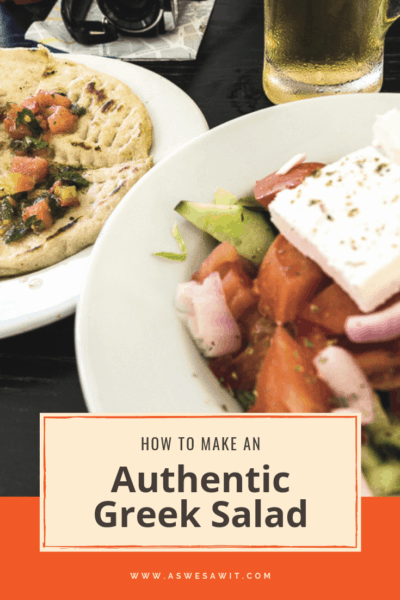
- a massive slab of real Greek feta
The whole thing is sprinkled with oregano and brought to your table glistening with fragrant, emerald olive oil. You’ll find it served this way everywhere from village tavernas to some of the best Athens restaurants.
That’s it.
Okay, maybe some cooks do add a splash of red wine vinegar when the tomatoes need a little help. But anything else is an abomination.
💡 PRO TIP: If you’re at a Greek restaurant and want the authentic version—with no lettuce—ask for horiatiki salata, pronounced “ho-ree-AH-ti-kee sa-LAH-ta.” Any place serving the real thing will know exactly what you mean.
Traditional Greek Salad recipe

Traditional Greek Salad (Horiatiki Salata)
Equipment
- large mixing bowl
Ingredients
- 3 medium tomatoes cut in wedges
- 1 small red onion sliced into thin rings
- 1 seedless cucumber sliced into half moons
- 1 green pepper sliced into strips
- 2-3 oz kalamata olives
- 1 block feta cheese cut into thick slabs
- 1/4 cup extra-virgin olive oil
- 1 tbsp dried oregano
- 1 tsp sea salt
Optional
- 1 tbsp red wine vinegar
Instructions
- Wash and slice tomatoes, cucumber, onion, and green pepper.3 medium tomatoes, 1 small red onion, 1 seedless cucumber, 1 green pepper
- Place vegetables into a large mixing bowl and toss, then add the olives.2-3 oz kalamata olives
- Sprinkle with salt and toss gently to combine. (If using the optional red wine vinegar, splash it on now).1 tsp sea salt, 1 tbsp red wine vinegar
- Place the thick slabs of feta cheese directly on top of the salad.1 block feta cheese
- Garnish with a heavy sprinkle of oregano and a generous drizzle of extra-virgin olive oil. Serve immediately.1 tbsp dried oregano, 1/4 cup extra-virgin olive oil
How is Greek salad served?

Traditional Greek salad is usually served in a shallow bowl, with the feta left in a slab on top rather than crumbled and mixed through. A basket of crusty bread often comes with it.
Regardless of the restaurant, our horiatiki always arrived at the table the same way: one shallow bowl for each of us. They usually brought plates too, just in case we didn’t want to eat straight from the serving bowl.
We preferred to ignore the plates, except for the one time we were each served a family-sized salad. It was far more fun to eat straight from the bowl, breaking off a salty chunk of feta and spearing it with a vegetable or two. Besides, we didn’t want to risk losing any of the peppery oil or stray morsels of feta that had made their way to the bottom.
How to eat a Greek salad correctly

It wouldn’t be a real Greek salad without the freshly baked, fragrant rounds that are served alongside. That crusty bread is the best way to soak up those last drops of deliciousness that remain behind in the bowl.
Sopping up that lovely liquid is so common that there’s an actual name for it: papara. As one diner in Corfu told us, it’s a perfectly acceptable custom in Greece, and you can only say you’ve eaten a horiatiki salad properly if you have “made a papara.”
If you’re among families and good friends, the custom is to prepare one large plate of horiatiki salata for the table to share. Everyone will eat out of the communal plate and join in the papara at the end.
That said, some people do prefer to take their own portion on their own plate. Most restaurants, especially in tourist areas, provide extra plates for those who want to divide the salad. So now that’s now how we do it when we make it at home. (Besides, it’s easier.)
Tips for the most authentic Greek salad

As with most simple dishes, the better your ingredients, the better your results. This is a peak-summer salad, best made when you can pull the ingredients straight from the garden. If you love vegetables, do yourself a favor and avoid those rock-hard, flavorless grocery store tomatoes that start showing up after the first frost.
You don’t need to import every ingredient from Greece, but the feta, olives, olive oil, and oregano matter. Using the right feta, olives, olive oil, and oregano is the secret to getting that genuine taverna flavor at home.
- Feta cheese. Authentic Greek feta is legally protected (PDO) and must be made from sheep’s milk, or a blend of sheep and up to 30% goat’s milk. It is always served as a single, thick slab resting on top of the salad—never crumbled or cubed. Avoid the cow’s milk versions at all costs; they’re dry, rubbery, and completely lack the rich, creamy melt-in-your-mouth texture of the real deal.
- Tomatoes. A mediocre tomato will completely ruin this salad. Pick the ripest, most fragrant ones you can find, and leave them on the counter. Cold air destroys their texture and kills the flavor, so never refrigerate them before slicing.
- Purple onions: Also known as red onions, these add a sharp, colorful bite that cuts through the rich olive oil and creamy cheese. Slice them into thin, delicate rings so they don’t overpower the rest of the dish.
- Cucumbers. Crisp, fresh, and sliced into half-moons. Peeling is entirely up to you—leaving a little skin on adds a nice, rustic crunch.
- Green peppers. Stick strictly to green bell peppers. Their slightly bitter crunch balances the sweet tomatoes perfectly. Leave the sweeter red or yellow varieties for other recipes.
- Kalamata olives. Look for plump, shiny, dark purple olives. In Greece, they are almost always served with the pits still in, which keeps them firm and flavorful. If you can’t find good ones locally, you can grab authentic Kalamata olives on Amazon.
- Extra-virgin olive oil. Since this oil forms the entire base of the “sauce,” you need a robust, cold-pressed Greek olive oil with a peppery finish. You can source quality Greek olive oil on Amazon.
- Greek oregano. This is not the dusty, generic oregano sitting in standard pizza parlor shakers. Real Greek oregano (Rigani) is intensely aromatic, earthy, and slightly peppery. Give it a try and you’ll see exactly what I mean. You can find mountain-grown Greek oregano on Amazon.
What a real Greek salad does not have

As with most traditional dishes, understanding what doesn’t belong in the bowl is just as important as knowing what does.
Here are the biggest no-nos. If you see any of these ingredients in a “Greek salad,” it’s not a true horiatiki.
- Lettuce. Any restaurant padding your plate with romaine or iceberg is either clueless or just trying to economize by using cheap filler.
- Feta crumbles. Real Greek salads have a massive slab of feta on top. Aside from looking beautiful, it actually provides a whole lot more protein than you would get from a couple of tablespoons of pre-crumbled cheese. (It also costs the restaurant more to serve it this way. Just saying.)
- Croutons. Horrors! Bread belongs on the side for making a papara. And with all those raw veggies, who needs more crunch?
- Meat. Of any type.
- Potato salad. Restaurants around Tarpon Springs, a Greek community north of Tampa, Florida, always serve their Greek salads with a scoop of mayonnaise-laden potato salad. Seriously, that’s an even worse sin than croutons.
- Lemon. Greeks use lemon on almost everything, but it has no place in a classic horiatiki. Unless you’re in Cyprus—but Cypriots add shredded cabbage and leave out the olives, so I’d never order one there.
Inspired? Pin this post and save it for later!


This looks great! We are always looking for things to fix in hostels. This looks like a good one!
If you do make it, please come back and share your feedback. Dan likes to add a squeeze of lemon but I prefer it as is. Either way, it is just about the fastest and easiest salad we’ve ever made, so fresh and inexpensive, and I would bet you’ll have no leftovers!
Thanks for a great post and for reminding me about this great salad that I used to make when I lived back in Romania. It’s soooo tasty!
Isn’t it fabulous? I hope you have the chance to enjoy it again soon.
I’m a big salad fan, I’ll definitely try out this recipe