
Kinderdijk is one of those places that looks exactly like the Netherlands is supposed to look—long canals, big sky, and a row of traditional windmills standing shoulder to shoulder.
With 19 historic windmills still in place, it’s now a UNESCO World Heritage Site and one of the best spots in the country to see how the Dutch have kept their land dry for centuries. We’ve visited twice on river cruises—once focusing on the windmills themselves, and another time choosing an alternate shore excursion.
If you’re planning a visit, whether by cruise or as a day trip from Amsterdam or Rotterdam, here’s what to know before you go: how to get there, what it costs, and what’s actually worth doing once you arrive.
Plan your Kinderdijk visit
We’ve visited Kinderdijk on Rhine River cruises, where the logistics are handled for you. But many visitors arrive independently from Amsterdam or Rotterdam. If that’s you, here’s what to know—from getting there to how much time you’ll actually need.
How to Get to Kinderdijk
Kinderdijk is located about 15 kilometers southeast of Rotterdam. making it accessible for day trips from several Dutch cities. You can get there yourself or book a guided tour that bundles transport, entry, a guide, and extras like Delft or a cheese farm in the excursion.
By River Cruise: This is the most convenient option. Most Rhine river cruises (including Viking, AmaWaterways, and Uniworld) dock within walking distance of the windmills. It’s one of the most convenient ways to visit, as transportation and often a guided tour are included.
By Bus from Rotterdam: Rotterdam is the closest major city to Kinderdijk—roughly 35 minutes by bus. Line 489 runs directly from Rotterdam Kralingse Zoom to Kinderdijk Molenkade, twice an hour, seven days a week.
By Waterbus from Rotterdam: You can also take the Waterbus from Rotterdam to Kinderdijk. It’s a scenic half-hour ride. In summer, direct line 202 runs from Rotterdam; in other seasons, use line 20; it operates year-round but may require a transfer at Ridderkerk.
If you’d rather sort it out in advance, you can pre-book a WaterShuttle ticket to Kinderdijk and board at any of the official Waterbus stops. Look for the blue Waterbus flags and timetable boards at the dock.
By Public Transport from Amsterdam: Public transport takes 2-3 hours each way—which adds up to half a day in transit: Train from Amsterdam Centraal to Rotterdam Centraal → take the metro or tram to Rotterdam Erasmusbrug or Zuidplein → catch the Waterbus to Kinderdijk. Which is why most people book a tour or rent a car.
By Car: The drive from Kinderdijk takes about 20–30 minutes from Rotterdam and 60–75 minutes from Amsterdam—assuming traffic cooperates. On-site parking is limited; most visitors use the Park & Ride in Alblasserdam and take a shuttle bus to the Kinderdijk entrance. As of 2026, the parking fee is €9.75/car.
If you’re renting a car to explore the Netherlands, you can compare car rental rates here.
👉 Prefer not to deal with transfers? This 5-hour Kinderdijk tour from Rotterdam includes a scenic boat ride to Kinderdijk, a walk among the windmills, and a visit to a cheese farm. Or take a private day tour from Amsterdam to see Kinderdijk windmills, explore Delft, and visit the Delft Blue factory.
Best Time to Visit Kinderdijk
Time of Day: Early morning (before 10am) or late afternoon (after 3pm) offer the best light for photography and smaller crowds. The golden hour just before sunset creates particularly stunning photos when the low sun illuminates the windmills.
Season:
- Spring (April-May): Tulips may be blooming in nearby fields
- Summer (June-August): Warmest weather but most crowded
- Fall (September-October): Beautiful colors, fewer tourists
- Winter: Atmospheric but some windmills may have limited hours
Special Events: During the second week of September, all 19 windmills have their sails turning simultaneously for National Mill Day—a spectacular sight if you can time your visit right!
Kinderdijk Tickets & Practical Information
Entrance Fee: Adults: €21.00 | Children (4-12): €9.00 | Under 4: Free (Prices as of 2026)
Hours: Generally, 9:00 a.m.–5:30 p.m. daily, with extended hours in the summer. Some windmills close earlier in winter months.
What’s Included: Your ticket includes access to the walking paths, one or two windmill interiors, the pumping station museums, and the visitor center. The canal boat tour requires an additional fee (about €6-8).
How Long to Spend: Plan to be here for 2-3 hours. This gives you time to:
- Walk along the dikes between windmills (30-45 minutes)
- Tour at least one windmill interior (20 minutes)
- Visit the pumping station museum (20-30 minutes)
- Take photos and enjoy the scenery
If you want to take the canal boat tour or visit multiple windmills, your visit will likely be 3-4 hours long.
Accessibility: The site has paved paths suitable for wheelchairs and strollers. The canal boat is wheelchair accessible, though the windmill interiors involve steep, narrow stairs and are not suitable for those with mobility limitations or claustrophobia.
What to Bring
Based on our experience, here’s what we recommend:
- Comfortable walking shoes – You’ll be on your feet for a couple hours
- Camera or smartphone – The windmills are incredibly photogenic
- Water bottle – Especially in summer
- Light rain jacket – Dutch weather can be unpredictable
- Sunscreen and hat – There is limited shade along the paths
- Cash – For the gift shop and optional boat tour, though cards are accepted most places
Things to do at Kinderdijk windmills
There’s more to do here than just snap a few photos — although yes, you’re going to take a lot of them. The windmills lined up along the canal are about as postcard-perfect as it gets.
Several of the windmills are still inhabited. The millers who live in them maintain these protected monuments, even though modern pumping stations now control the region’s water levels.
If you do one thing, make it climbing inside a windmill. Seeing the pumping mechanism up close—and the surprisingly compact living quarters—is mind-blowing. Imagine what it would be like to live there!
💡 PRO TIP: Do not enter a windmill if you are uncomfortable in small areas.
Also worth your time:
- Visiting the pumping station and museum
- Taking the canal boat for a different view of the windmills (it’s wheelchair accessible)
- Walking (or biking) along the dikes
- Stretching out on the grass and simply enjoying the scenery
- Browsing the gift shop (if you’re into that sort of thing)

Frequently Asked Questions
Is Kinderdijk worth visiting?
Yes — especially if you’re interested in how the Netherlands actually manages water. The windmills aren’t decorative. They were part of a working system that kept entire regions from flooding, and you won’t find it anywhere else in the world.
How many windmills can you go inside at Kinderdijk?
Typically 1-2 windmills are open for interior tours, included with your entrance ticket. These show both the pumping mechanisms and the living quarters where the windmill keepers’ families lived. Note that the interiors involve steep, narrow stairs.
Can you visit Kinderdijk independently or do you need a tour?
You can absolutely visit independently. The site is well-marked with informational signs in English, and you can explore at your own pace. That said, a guided tour (whether through a river cruise or day tour) provides valuable historical context that enhances the experience.
Is Kinderdijk better than Zaanse Schans?
Kinderdijk and Zaanse Schans offer very different experiences. Zaanse Schans is closer to Amsterdam and easier to reach, but it’s more commercial, with souvenir shops and staged demonstrations. Kinderdijk feels more authentic—it’s a UNESCO World Heritage Site with 19 historic windmills still standing in their original landscape, and several are still inhabited. If you only have time for one, Kinderdijk delivers the more iconic and atmospheric Dutch windmill experience.
Are bikes available at Kinderdijk?
Yes. You can rent bikes at the visitor center to explore the paths between the windmills. It’s a lovely way to explore the site, though walking is perfectly fine too—the entire loop is only about 3 kilometers.
Can you see the windmills without paying?
You can see the exterior of the windmills from public areas without paying, but you’ll need a ticket to access the interior of the windmills, the museums, and the full network of paths for the best views and photo opportunities.


Visiting Kinderdijk on a River Cruise

If you’re on a river cruise, you don’t arrive at Kinderdijk by bus. You glide in.
The windmills show up first — rising above the pancake-flat landscape — and you realize this isn’t a staged attraction. This is the real thing, sitting exactly where it has for centuries.
Kinderdijk is usually the featured shore excursion, and that makes sense. Walking between the mills, climbing inside one, and seeing how the water was actually moved out of the polders gives the whole place weight. It stops being a postcard and starts being infrastructure.
The excursion included time inside one of the windmills and a visit to the pumping station, which made the engineering behind the landscape much easier to understand.
On a later sailing, an alternative was offered for anyone who’d already toured the windmills before: a visit to a small dairy farm to see how the renowned Dutch cheese is actually produced. We went. It was interesting to see Gouda made on site and taste it fresh—but if you haven’t stood inside a working windmill yet, that’s where your time belongs.
Our Final Morning Cruising to Kinderdijk
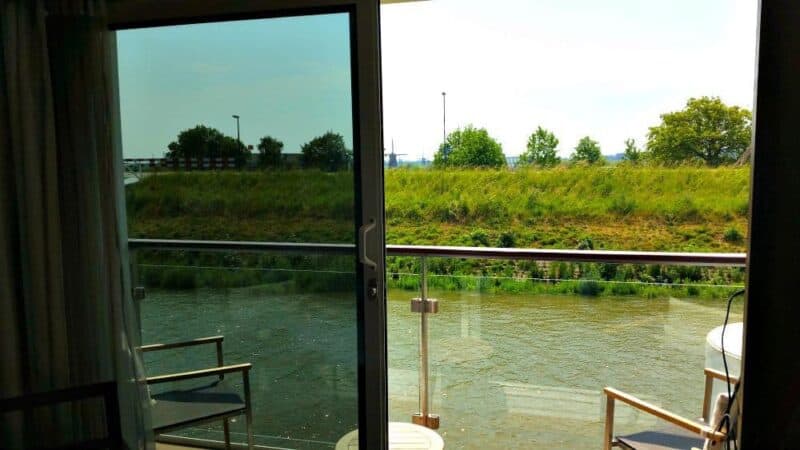
We’d be spending the day in Kinderdijk today. This is a picturesque community with 19 historic, working windmills.
This begs the obvious question, why are these particular windmills so exceptional? After all, these ingenious machines have been around since the Middle Ages and they can be found in every corner of the country. Considering that over one-quarter of the country lies below sea level, for all intents and purposes Holland wouldn’t be on the map without them. Saying “You can see them everywhere” is not overstating it.
Several river cruise itineraries include Kinderdijk, so for those repeat passengers (like us) who had already toured the site, Viking thoughtfully offered an alternative: touring a cheese farm to see how Dutch cheese is made.
But wait. I digress. We had one last morning aboard.
Scenic Cruising Through Holland’s Waterways
Our morning began with the typical expansive breakfast buffet, this time with Dutch pastries, breads, and other specialties. We joined the others, lingering over coffee while we watched the scenery along the Rhine. The scenery’s flavor had definitely changed, from German to Dutch.


Learning About Dutch Water Management
Our Program Director Dewi was scheduled to give a presentation on Dutch water management at 10:30. Just enough time to pack.
Trust me: It pays to travel light. With just a couple of carry-ons for clothing and one small backpack for electronics, it didn’t take long to pack everything up. Aside from a few toiletries, a change of clothes for tomorrow, and our electronics and charging cords, we finished long before her talk began.
Dewi’s talk was actually really interesting. Climate change is an especially urgent concern here, as the country lies even further below sea level than New Orleans does.
She explained more about the expansive system of dams, dykes, and dunes that Netherlands must maintain for its wellbeing. Keeping the land free from flooding requires a lot more thought and preparation than I had realized!

Spotting Noah’s Ark on the Rhine
And speaking of epic flooding, there’s an actual ark in the Netherlands! When a Dutchman named Johan Huibers dreamed that the Netherlands was overwhelmed by a flood similar to the one in the Bible, he was inspired to rebuild the ark to the same proportions that God had given to Noah.
Johan’s ark is moored on the Rhine at Dordrecht, south of Rotterdam. Huibers kindly put life-sized animal statues on its deck to help give an idea of its proportions.

Having seen it on our prior cruise, I knew that we would pass right by it, so I made sure to tell Dewi that I’d like her to give me a “heads up” and point it out as we passed. Dewi asked the Captain to tell her when we were approaching so she could let us know.
It’s easy to miss unless you know to look for it.
ⓘ TIP: If you’re choosing between excursions, pick the windmills. You can see cheese made anywhere. There’s only one place in the world with this concentration of historic working windmills.
Arriving at Kinderdijk
Even though both the ark and Kinderdijk (Dutch for “child dike”) are located near Rotterdam, our cruise schedule allowed us enough time to enjoy a delicious lunch before we docked.
ⓘ TIP: Unsure which activity to join? Well, you can see cheese made worldwide, but Kinderdijk is the only site in the world with so many historic Dutch windmills. So, yeah: Faced with the choice, you should see the windmills.

Visiting a Dutch Cheese Farm in Giessenburg
If you’ve already toured the windmills on a previous cruise, some itineraries offer an alternative shore excursion to a nearby dairy farm.
Ours took us to a small family-run operation outside Kinderdijk, where we followed the process from milk to finished wheel — stepping inside the production room and into the aging racks stacked with Gouda.

Inside the aging room, shelves were stacked high with rounds of Gouda at different stages of maturity. The younger wheels were mild and creamy; the older ones had deepened in color and developed that firm, crumbly texture the Dutch are known for.
It’s not a substitute for Kinderdijk — the windmills are the reason you’re here — but it was an interesting look at another piece of Dutch life, and a good option if you’ve already toured the mills on a previous visit.

The farm has a lovely gift shop and offers samples of all their various gouda flavors. Dan and I sampled them all, and we couldn’t resist buying three different types to share with our family back in America.

Back on board
Back on board, the afternoon program included a lecture on Dutch history and the centuries-long fight to control water. After walking among the windmills at Kinderdijk, that engineering story felt far more tangible than any slide presentation could. Seeing the machinery in motion made it clear that this landscape wasn’t decorative — it was survival.
Kinderdijk isn’t just a scenic stop on a Rhine itinerary. It’s a working reminder of how the Netherlands was literally built by managing water.
ⓘ TIP: If you’re on a river cruise, don’t miss the opportunity to see Amsterdam yourself before you fly home. If nothing else, you should at least take a canal cruise. After all, that’s what the city is best known for!
- Next stop: Amsterdam
More Planning Resources
If Kinderdijk is on your river cruise itinerary — or you’re planning to visit from Rotterdam — these links will help you figure out how to spend your time.
- Travel Guide: Rick Steves’ Amsterdam & the Netherlands is the top-selling travel guide on Amazon.
- Lodging: Find accommodation options near Kinderdijk here.
- Transportation: Rome2Rio shows how to get anywhere by plane, train, bus, ferry, and car.
- Photo Gallery: Browse our Kinderdijk photo gallery for more inspiration.
- Map: Get a bird’s eye view on Google Maps here. Zoom, scroll around and explore!
- Save this for later: Pin it to Pinterest or share it on Facebook so you can find it when planning your trip!
💡 PRO TIP: If you’re visiting Amsterdam after your Kinderdijk trip, don’t miss taking an Amsterdam canal cruise—it’s what the city is famous for! Read about our one day in Amsterdam here.
Note: As is common in the travel industry, Dan and Linda were provided with a complimentary cruise package for the purpose of review. While it has not influenced coverage, AWSI believes in full disclosure of all potential conflicts of interest. For more information, see the Disclosure page.
I am going here next year and I am so excited! This was so informative!!! Thank you so much!
You’re welcome, Jane. We hope you have as good a time as we did.
I flew home just a week ago today, from the wonderful Viking Rhine River Cruise. It was so fun to come across your photos and once again see things I experienced. The farmer & his wife gave such an interesting tour of their Gouda cheese farm. I wish I had bought more of their cheese! Very fun to see your photos of the same countryside and windmills that we visited. Thank You!
You’re welcome, Margy. We’re so pleased that you enjoyed our story.
Did you take the Rhine River cruise or do the whole Grand European Tour from Budapest to Amsterdam? What was your favorite stop?
Linda
Oh wow! It’s beautiful!!!
I’ve only been to Zaanse Schans to see the windmills and I have to say that I do love the very green and “watery” scenery of Netherlands. Love the ark! 🙂
Yes, the Netherlands’ watery scenery is quite special. I’m still intrigued by that ark.
Wow, that arch is amazing! I had no idea something like that actually existed! I would love to see that! I love cruises, but sometimes it’s a little hard to see everything in such a short time. Looks like you made the most of it though! Those windmills are beautiful! They reminded me a lot of the ones in Spain, in the land of Don Quijote 😀 And that cheese farm! I consider cheese it’s own food group and could never get enough, so this experience looks top notch! Free gouda samples—sign me up!
We haven’t had the opportunity to see any of the Spanish windmills, but I’ll be honest: Don Quixote has come to my mind too. I wonder if Spanish manchego cheese is made the same way as gouda?
I have always wanted to do a river cruise. Cruising down the Rhine would be classic. Your photos make it look so wonderful!
It would be hard to decide between the windmills and cheese. I do understand you reasoning for the windmills and I know I would want gorgeous photos of the windmills too! But that gouda looks pretty good!! haha Thanks so much for sharing!!
Yeah, Viking made sure that the choices were pretty good, either way. Still, our family was happy we had decided to go to the cheese farm. They enjoyed sharing the gouda!
What an interesting post about Holland! I always wanted to visit the country of windmills and tulips. I love the story about Noah’s Ark replica. It must have been very interesting to visualize what it must have looked like. And that tour of the Dutch cheese farm… makes me want to run out the door and buy some cheese.
Yeah, Noah’s Ark looked a bit odd without a bow. But when you stop to think about it, Noah didn’t need one, as he wasn’t trying to go anywhere. He was just trying to stay afloat. 🙂
How cute is that cow?! All of that cheese looks delish!
Yes, she was cute. Dan got some really fun photos of cows while we were there. This was my favorite.
What an awesome day! I remember visit Volendam and going to a cheese farm too. There were so many variety of cheeses to try. It is one of those memorable experiences you never forget. Gouda has always been one of my favorite cheeses and trying it from a producer was great. That Noah’s Ark looks interesting!
Visiting a cheese farm was definitely one of the highlights because I’m such a cheese fan and like you said, it was a memorable experience. I’d have to say that my favorite type of Gouda is smoked and I was surprised that they didn’t offer it. Do you have a favorite?
I can’t believe there is actually a Noah’s Ark! It’s how I imagined it to look like too. Looks like a wonderful river cruise, I do like looking at a good windmill!
The next time we visit I really hope we can actually go inside and see how he’s decked it out. It sounds rather elaborate!
I live in the Netherlands, and it’s fun to read an outsider’s view of the place! Kinderdijk is indeed lovely, and the river cruise seems a great way to get a first impression of the Netherlands! In my experience the Dutch aren’t particularly worried about the sea level rising. They seem remarkably confident that they can deal with it, as the world’s experts on water control.
I’d like to warn your readers about something else, though: taking the cheese home on the plane. Dutch cheese has exactly the same density as plastic explosives, so you are very likely to get your carry-on bag searched going through security. It’s not a problem, because they’ll see it’s just cheese, but it’s worth being aware that it’s likely. If you put it in your checked bag, you run the same risk, so leave it at the surface so anyone opening your bag will see it right away and not mess up your careful packing!
Two very good tips about the cheese. I have heard that security doesn’t mind cheese as long as it’s been sliced, but that you may lose your food if it is in a wax-covered ball so they can’t verify what it actually is.
On a side note, we’ve also learned the hard way that it’s better to put your tripod on TOP of your clothes. The security newbies seem to get a bit nervous when they see a bunch of metal pipes…. 🙂