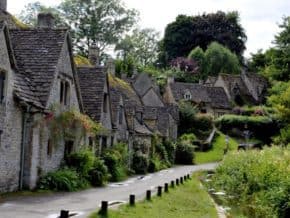
Most first-time visitors to England head for the famous places—London, Bath, and the Cotswolds. And that makes sense. London is London, Bath is elegant and beautifully preserved, and the Cotswolds are ridiculously picturesque.
Then there’s Northumberland, way up at the northern edge of England. Northumberland feels quieter and rougher around the edges than England’s better-known destinations, and that’s part of the appeal.
Within a fairly short drive you can move from long North Sea beaches lined with castles to the rugged hills of Hadrian’s Wall, then out to Holy Island across a tidal causeway.
Exploring the county works best by car. Not because distances are huge, but because the landscape keeps changing. One stretch of road runs past a medieval castle above an empty beach. The next turns inland across open hills where the remains of Rome’s northern frontier still cut across the countryside.
Newcastle makes a convenient place to start exploring Northumberland. From here, several different road trips unfold—along the castle-lined coast, across the Roman frontier, out to the tidal island of Lindisfarne, or into the quieter border hills.
Northumberland Road Trip Ideas from Newcastle
| Route Section | Best For | What It Feels Like | Main Practical Catch |
| Alnwick → Bamburgh (Castle Coast) | Castles, coast, first-time visitors | Dramatic, open, easy to read | Temptation to rush past smaller stops |
| Hadrian’s Wall Drive | History, walking, landscape | Sparse, layered, thoughtful | Sites are spread out |
| Holy Island Drive | Tidal drama, spiritual history | Unusual, atmospheric, time-sensitive | Crossing depends on tide times |
| Cheviot Hills Border Drive | Quiet scenery, slower travel | Remote, windblown, introspective | Fewer services, longer empty stretches |
The Castle Coast Route
Newcastle → Alnwick → Seahouses → Bamburgh
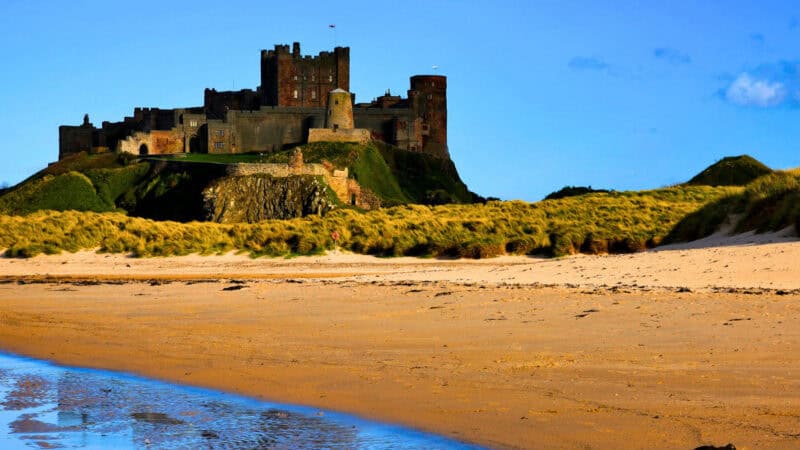
The easiest road trip from Newcastle heads north along the coast toward Alnwick and Bamburgh. This stretch of shoreline has some of Northumberland’s most recognizable scenery, with medieval castles rising above wide North Sea beaches.
The coast between Alnwick and Bamburgh is one of the most dramatic stretches in Northumberland. It is not loud and showy, but just confident.
Alnwick makes a softer starting point, a market-town base with enough history to ease things in. Then the road north begins to open and narrow, dip toward the sea, and wind past small villages with sudden views of the coast.
Bamburgh, when it appears, does not need much introduction. The castle dominates everything, but the wide beach below it is just as memorable.
This route suits travelers who prefer places with shape and atmosphere over endless attraction-hopping. Seahouses works for anyone wanting something busier and more practical, but the real value of the route is cumulative.
Castle ruins begin to feel less like isolated sights and more like markers of an older coastal story built around defense, trade, and the constant pressure of the North Sea. It’s hard not to feel that history when you’re standing there.
Northumberland’s coast is not delicate. Rather, it feels exposed. That gives even a short drive a bit of weight.
Hadrian’s Wall Drive Across the Roman Frontier
Newcastle → Hexham → Chesters Roman Fort → Housesteads → Steel Rigg
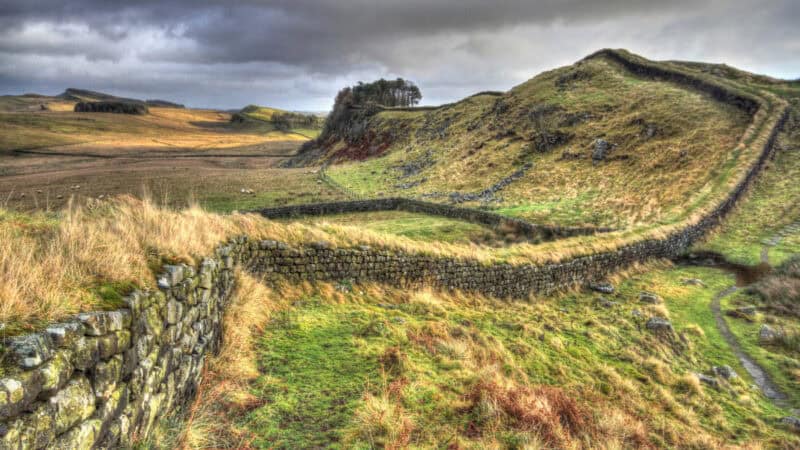
Another easy drive from Newcastle heads west along the Tyne Valley toward the rugged landscape around Hadrian’s Wall. This part of Northumberland feels completely different from the coast, with open hills and scattered Roman sites stretching across the old frontier.
The Roman frontier is not just one stop, and that is where some trips go wrong.
Too often, it gets treated like a monument, something to arrive at, photograph, and leave behind. It works better as a corridor, something followed rather than merely visited. The forts, the undulation of the ground, the sense of edges and distance, all of that matters.
Gradually, the logic of the line becomes clearer, along with the reason it still catches the imagination centuries later.
There is also a useful contrast at play. Northumberland’s coast is visually immediate. Hadrian’s Wall asks more from a traveler. The landscape has to be read more slowly, with a bit more patience, with some willingness to imagine the infrastructure that once connected these seemingly remote places.
It is not flashy travel. Rather, it is interpretive travel, if that phrase does not sound too academic. Still, that is what makes it stick. The experience is less about one perfect viewpoint and more about the gradual accumulation of place, ruin, distance, silence, then another fort, another ridge, another reminder that borders never feel abstract when standing on one.
Holy Island Drive and the Tidal Causeway
Newcastle → Alnwick → Beal → Holy Island (Lindisfarne)
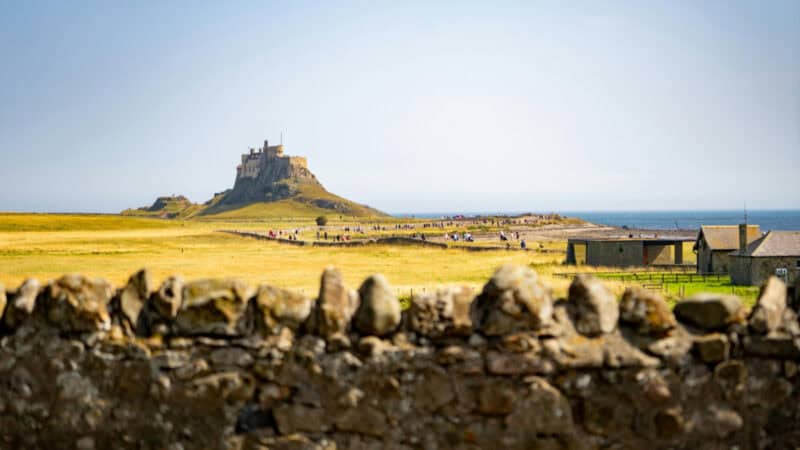
From Newcastle, the drive north toward Holy Island takes you along the coast before turning inland toward the tidal causeway to Lindisfarne.
Lindisfarne has the sort of arrival that does half the storytelling for itself. The tidal road changes the whole psychology of the visit because the place is not always available on the visitor’s terms.
The crossing happens when the sea allows it. That sounds simple enough, yet it alters the mood before the car is even parked. The island feels both connected and set apart, which is probably why its religious and historical associations land so strongly.
It is not merely scenic. Rather, it has a strange, held-back energy. That is part pilgrimage site, part working landscape, part place people still misjudge because they forget the tide does not care about holiday plans.
If the castle coast is about spectacle and Hadrian’s Wall is about depth, Holy Island sits somewhere between the two. There is visual drama, yes, but also a sense of vulnerability. Wind, mudflats, causeway, ruins, all of it creates a more fragile feeling than Bamburgh’s hard profile or the Roman wall’s stubborn lines.
It is worth building the day carefully rather than squeezing it in. Also, tide windows matter. So does allowing enough unstructured time to walk, pause, and let the place settle. Some destinations are consumed quickly. Lindisfarne resists that, quite rightly too.
Cheviot Hills Border Drive
Newcastle → Rothbury → Wooler → Cheviot Hills border roads
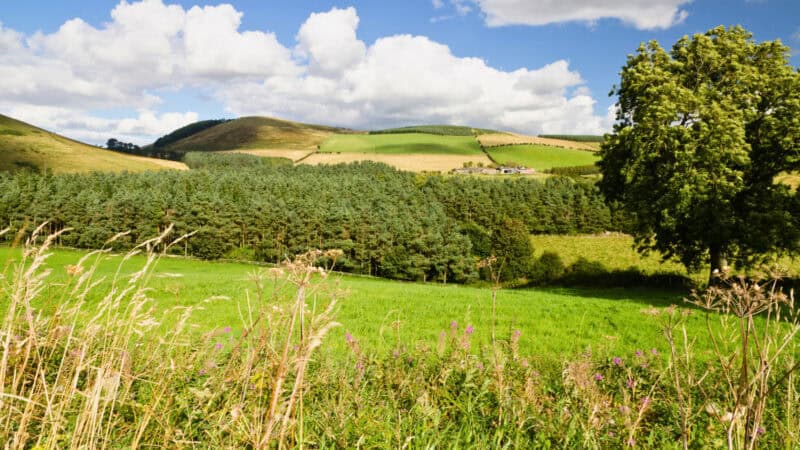
For travelers who want a quieter drive, head north from Newcastle into the Cheviot Hills near the Scottish border.
Then there is the border country, the Cheviot Hills and the roads that seem to slip away from certainty. This is the least theatrical part of the trip and, for some travelers, the most memorable. There are fewer obvious icons here.
What appears instead is mood, distance, sheep-dotted slopes, a weather-beaten quietness that feels genuinely removed from England’s better-known touring circuits. It is the kind of landscape that makes voices drop without much notice. Nothing dramatic is happening. The landscape simply invites you to take your time.
Driving through these hills removes any feeling of the need to be productive. There are no major landmarks every fifteen minutes, and that is precisely the point—the drive itself becomes part of the experience. That may sound indulgent, but Northumberland can carry it.
Basically, the county has enough visual and historical density elsewhere that these quieter roads do not feel like filler. Also, they feel like a balance.
Compared with castles and saints and Roman frontiers, the hills prove that not every memorable travel moment arrives with a ticket desk or an information board. Sometimes it is just a bend in the road and that odd, clean feeling of having reached the edge of somewhere.
Getting Around Northumberland
Newcastle works well as a starting point for exploring Northumberland, but once you leave the city the public transport options thin out quickly.
If you want to visit places like Bamburgh, Holy Island, and Hadrian’s Wall on the same trip, getting between them by bus or train can take longer than the visit itself.
Most travelers rent a car for a Northumberland road trip. But if you’re traveling with a larger group, arranging Coach Hire Newcastle service for the group can be easier than coordinating multiple vehicles.
Why Northumberland Works So Well as a Road Trip
Northumberland isn’t a place you visit for one headline sight. The region’s appeal is how much the landscape changes as you move through it—castles on the coast, the long line of Hadrian’s Wall, the tidal crossing to Holy Island, and quiet roads near the Scottish border.
Seen together, they make some of the most rewarding road trips in England.